
Welcome to my annual book review. See prior versions here: 2023, 2022, 2021, 2020, 2019, 2016, 2015, and all time.
Last year I wrote that I would run two experiments in 2024:
- To read more actively
- To consider alternatives to reading for learning
On the second experiment, I would rate myself a 6 out of 10. I still primarily default to books, podcasts, and ChatGPT. I don’t use YouTube that much.
I would rate myself an 8 out of 10 on reading more actively. I tried to pick up books that have some direct application to what I was doing.
As an example, when I read Peter Attia’s book Outlive, I did a detailed blood marker test via Function Health. Based on those results, I started to take supplements and changed my exercise pattern.
Or, as another example, when I read Richard Schwartz’s book, You Are the One You’ve Been Looking For about Internal Family Systems (IFS), I started working with an IFS therapist.
In addition to pairing reading with follow-up actions, I’ve been using ChatGPT to read more actively. When reading non-fiction books, I use it to ask questions to clarify what I’m reading.
I’ve also been using AI to distill and remember a book’s key concepts. For instance, I’ve used Gemini to create questions and answer pairs based on my Kindle highlights. Then, I pop those into Anki, the spaced repetition app.
On to my top picks for 2024. I read 22 books this year. See my top 6 below. For the full list, check out my Goodreads.
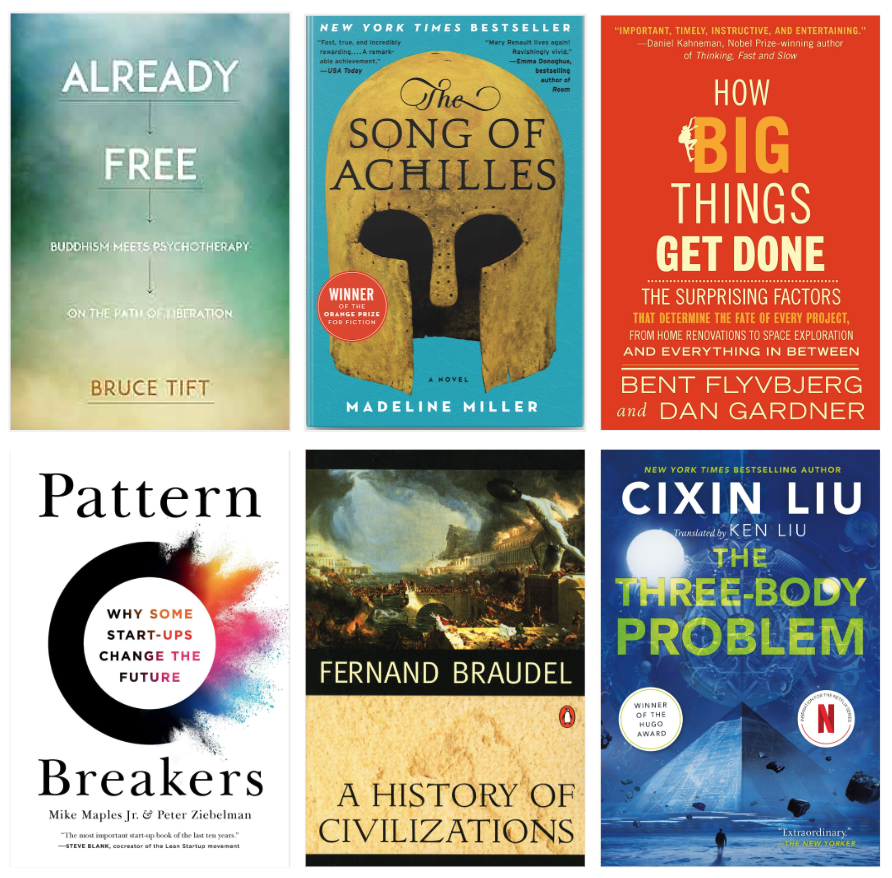
Already Free by Bruce Tift
This book was recommended to me by my friend Aart. It’s written by a lifelong meditator and psychotherapist. In it, he tries to marry Eastern and Western views on psychology. The Western view, which he calls developmental, supposes that by working on yourself, you can improve. The Eastern view, which he calls fruitional, supposes that sensations will never go away and that the practice is to be able to sit with them. I would highly recommend this book.
One of the key concepts that I still refer to regularly is the spectrum of separating vs. connecting. Tift writes that most of us have a tendency to either be connecting, which can mean pleasing others, or separating, which can mean declining requests for attention. This is something I have been playing with this year. Since finishing the book I have done a few one-on-one consulting sessions with Bruce and I intend to continue those.
Song of Achilles by Madeline Miller
This was the best-written novel I read this year. It’s set before and during the Trojan war, in which Achilles, Menelaus, and others fight against Troy. Izzy and I read this together and really enjoyed it.
How Big Things Get Done by Brent Flyvbjerg
This is an amazing book about why so few large projects get completed on time and on budget (only 8 out of 100 projects, according to the author’s extensive database), recommended by my friend Alex. The book starts with the story of the Empire State Building, which went from construction start to completion in just 1 year and 45 days. The book is written by an Oxford professor who has spent his entire career delivering big projects.
A key concept to deliver projects on-time and on-budget execution is modularity. This is why solar panels are such an incredible technology. As I was reading this book, I got increasingly excited about building big projects. I would recommend this book to any engineer, architect, or builder. The book also reminds me of Patrick Collison’s web page about rapidly delivered projects: https://patrickcollison.com/fast
Pattern Breakers by Mike Maples, Jr.
Maples is a Silicon Valley seed investor. While many books are written about how to start and grow a startup, few discuss what ideas are worth pursuing. That’s what this book is about.
Maples introduces two main concepts:
- Inflections. These are secular trends that change the landscape. For example, if AI reaches human-level intelligence and is given ways to act on our behalf, we might all have virtual personal assistants. Or, if solar and batteries become 80% cheaper, it might mean that the cheapest way to produce fuel is by producing it from zero-carbon power.
- Insights. These are non-obvious truths about how to harness one or more inflections to change human capacities or behaviors in a radical way. As an example, Wispr Flow, an AI dictation app, is powered by the insight that talking is more natural (and possibly faster) than typing.
I took a lot of notes while reading this book. It offered a great lens to look at businesses I am involved in and that I admire. It also offers a great framework to look at future companies.
History of Civilizations by Ferdinand Braudel
This is a history book written in the 1970s by a well-regarded French historian. He provides a sweeping history of human civilizations. I enjoy how Braudel draws broad trends while providing specific anecdotes. For example, the United States became a British colony, not a French one, despite the French being there first. Why? Britain sent many more people to America. When the British-French war broke out in 1760, there were 1 million British and only 60 thousand French. The book has some similarity to The Lessons of History by Will and Ariel Durant.
Three Body Problem series by Cixin Liu
I had read the first book in this three-part series a few years ago and read numbers two and three this year. These books are page-turners. Liu introduces a wide range of concepts, ranging from light speed propulsion to reducing the number of dimensions as a method to attacking other species. And, of course, dark forest theory: if there is other intelligent life in the universe, it is safest for them to not show signs of existence and to annihilate any other intelligent life without investigating.
I also loved the composition of the books. For example, I loved the stories Liu invents in book three, that hide secrets for humanity about the technology they ought to develop.
 Titiaan Palazzi Blog