“I’d rather live 50 years like a tiger, than one hundred years like a chicken”
Hubert Humphrey

“I’d rather live 50 years like a tiger, than one hundred years like a chicken”
Hubert Humphrey
Many of us express considerable admiration for individuals who by our own metrics have achieved success. In some cases, this can lead us to create in our minds a distance between the person admired and ourselves. You start to tell yourself “what he/she has accomplished, I can never be”. In that form, admiration is disastrous: rather than trying to solve meaningful challenges, you downgrade your own potential.
The thing is, the distance between the admired person and ourselves is imaginary – it is entirely created in our head. Accomplishment comes from setting big goals and acting tirelessly upon them. Change is created not by accepting naturally what others say, but by questioning all you hear and developing your own answers, based on what you truly sense is true.
Aspiration might be a healthier form of moving forward. If your aspiration is to achieve a truly meaningful goal you have chosen based on metrics you personally believe are important, aspiration is more actionable than admiration. The best and only way to make a change is to start acting!
I believe education can be a fundamental solution to many of the grand challenges humanity faces today. Poverty, disease, malnourishment and climate change – these are all problems that can best be solved by educating people about the problem and training them to find and execute solutions. But education needs to change completely from what it is today.
Luckily, many bright minds are working on new ways of bringing education to people. Online lectures, gamification and peer-to-peer tutoring are great examples of new forms of learning; they are becoming more commonly applied in classrooms around the world. But not only is it important to transform how we learn, what we learn should be changed dramatically also.
I find it fascinating to think about the skills that will make a difference in the future. Much inspired by books like Daniel Pink’s A whole new mind, below is the list of the skills I want to develop further — because I think they are critical to flourish in project world.
Build and lead teams. Practice the act of convincing people to support you. Only when one learns to adopt the perspective of others can you be truly influential.
Solve complex problems. In the real world, unlike in most courses, there is no set of guidelines available. You need to invent the roadmap yourself.
Develop big ideas. To make a profound change in the world, we need to work on big dreams and audacious projects. It is too easy to adopt the opinion of others, instead try to go deep and really question beliefs and knowledge. This requires to go deeper than most into the matter, and zoom out further to place things into context.
Improvise and play. Learn how to make things up on the spot and to give project a human edge.
Tell stories. In the flat world, storytellers triumph. This is true for the ventures we start but also for our personal lives. Human beings crave stories – and we love to help and spend time with people who are good at telling them.
Tinker and prototype. It is critical to be able to transform ideas into action. This may concern building a robot or writing a book – it is about the mindset of building things which are not yet perfect.
Identify and surf trends. By seeing ahead and identifying technological and social shifts, we can increase the chances to be “at the right place at the right time”.
Try things and take action. Start things that never were. The only way to be successful is to try a lot of things that might fail. Small failures are soon forgotten, large victories are not.
The list above is non exhaustive and non perfect. Please share the skills you find significant by email [titiaan.palazi@gmail.com] or at the bottom of this post. Thank you!
In today’s world, we have an enormous amount of possible projects to choose from. To be successful, we need to develop new tools to navigate this huge set of choices. In this post I share a method I personally started to use – the project paradigm.
Just two generations ago, careers were very linear. You were trained to become a mechanic, a doctor or an engineer and sticked with that job for most of your life. Of course, there were adventurers who traveled to foreign countries, but they were few and far between. The world was nicely organized.
Today, things are slightly more chaotic. In project-world, changing projects have become the norm and lifelong jobs the exception. The exponential growth of technology has made the world flat. With that increased connectivity and productivity, we can virtually start anything we can dream of and build it in a very short time. Goodbye cog-and-wheel, hello changing places!
With this tremendous increase in opportunity, the ability to choose between projects becomes critically important. Our old compass – find a nice position in a trustworthy company, be loyal – is no guarantee to success today. I want to share with you one of the solutions I implement: the project paradigm. A set of simple, but fundamental, questions I ask myself before the start of each project.
Be aware: the paradigm is highly personal. When you read the questions below, please reflect whether you find them of critical personal importance. I try to undertake only projects for which I can answer a confident “Yes!” to all questions.
Like every other experimental result, your paradigm needs to be calibrated. Think about a project that you truly loved, and assess whether it passes all questions of your project paradigm. If not, your set of questions may be incorrect or – important! – may have evolved over time.
I hope the method above is useful to you. If you have any thoughts or suggested changes, please share them with me. Also, if you use different tools to choose projects – or trust only on your gut – let me know also, I am keen to learn how others make their decisions.
Looking forward to hear your responses – please post them at the bottom of this article or email me.
It all started in NYC…
Bringing a sponsored delegation of 35+ Kairos fellows from the Netherlands to the annual Kairos Summit was the result of six months of hard work with Mingus Vogel & Frithjof Wegener. Not only were we the largest non-US delegation present at the forum, but also did the quality of the Dutch group far exceed all expectations. Others agreed – click here to see our feature in Sprout Magazine.
The time in NYC was amazing. I had the opportunity to discuss Kairos’ global strategy with a twenty-odd group of global fellows, hailing from China, Hong Kong, UK, Sweden, Spain, US and the Netherlands. I connected to 50 of the most promising student led start-ups in the world. I started and deepened friendships with people who were putting all their energy into making a change in this world. I celebrated the event with an unforgettable party on the trading floor of the New York Stock Exchange. And it was wonderful to finally spend time in person with people I had been working with so much through email and phone. Thanks Vic, Sam, Dylan, Andreas and Ted!

After 5 days of overwhelming experiences in the Big Apple, it was time to head to Boston on the evening of Superbowl Sunday. Not an avid sports fan myself, I missed the game during the 4-hour bus ride to Boston, only to find out that the New England Patriots (supported by most people in Massachusetts) had been beat by the NY Giants. Luckily, my new roommates weren’t big sports fan either – they invited me to join a forget-the-loss-and-celebrate-anyway party in Cambridge. A very warm welcome to a new home.
MIT is probably one the easiest place on this planet to make yourself at home. Within the first days, I learned about the future of digital screens at the MIT TechFair [very cool video here], I got a desk in an office with four ultra smart PhD’s at the MIT Engineering Systems Division and I started taking my first classes. True to my nationality, I bought a bike within 24 hours of arrival in Cambridge. And no lack of good times with new friends — I had dinner with a new group of people for each of the first seven days.
During the first weeks, I was immediately confronted with the density of great people at MIT. My second week at MIT, I had the pleasure to attend a business model workshop by Alexander Osterwalder; a presentation by Amory Lovins – the most impactful advocate of sustainability driven by enterprise; and a lecture on life lessons by Joi Ito, the MIT Medialab director and founder of the first Japanese Internet Service Provider.

But not only does MIT offer the opportunity to listen to great people, you can start very personal conversation. The amount of students, entrepreneurs and MIT faculty I met over the past month with the goal to start new projects has been amazing. Everybody is open to discuss big ideas, and people love to get their hands dirty working on turning them into reality. Within a matter of days, I had discussions with CEO’s, governmental leaders and directors of MIT research labs and faculties.
Next to my research, I have taken the opportunity to participate in a handful of classes at MIT. These classes allow me to work with the rich variety of people within MIT: business-savvy Sloan MBA’s and Sloan fellows; creative geniuses and product designers from the MIT Medialab; save-the-planet-engineers at MIT’s D-lab and holistic systems thinkers at the MIT Engineering Systems Division. The courses I’m taking vary from Media Ventures – which is all about building a company around the future of media and communications – to Power & Negotiations, which teaches you to become a hard-nosed dealmaker (practicing negotiations for 1.5 hours each class!).
But I’m not here to only listen and talk — I’m here to start exciting projects and build meaningful solutions! Over the course of the past three weeks, I’ve been exploring a solar panel cleaning business, a new battery cathode technology and a children’s storytelling software app. Currently, I’m working with two great teams: one on biomass gasification in India and another on a software application that taps into the power of social by empowering people to accomplish challenges by incentivizing their friends.
These ideas will hopefully lead to participation in the myriad of competitions here. Competitions I’m preparing for – such as the MIT IDEAS challenge, the Clean Energy Prize and the MIT100K – reward winners with prizes ranging from small grants to giant budgets and incentivize students to solve important problems. If you are looking for inspiration in another form, you can attend one of the many amazing speaker series – at the Deshpande Center, the Harvard Business School or the Martin Trust center for entrepreneurship.

Shifting from the past to the future, the month of March promises to be even more exciting than the past 30 days! Next weekend I will be in NYC – to meet long-lost friends and learn the art of 3D-printing; the weekend after I will be blogging at the MIT Energy Conference; and the last 10 days of March will be spent in San Francisco and Silicon Valley.
All in all, I’m having an amazing time here. I feel like a painter who has received a new canvas to design his life upon, and I’ve started this month to put down the coarse outline. The more people I meet, the more color is added to the piece – and I’m curious to see what things will look like in a couple of months. I will have worked with wonderful people to start important projects; I will have learnt from all the great professors around me and I will have built friendships with people from all kinds of backgrounds which I hope to kindle for many years to come. May the next months be as spiced up as the Sichuan dinners I get around here!

So far, I have had a blast during my time here in Boston. I have never had such a smooth landing upon moving to another country. MIT and the surrounding Cambridge area compose a truly wonderful place to live – and a stimulating environment to work in. But why is it that MIT is such a breeding ground for new ideas, projects and companies? Below some of my thoughts, triggered by a conversation with my thesis supervisor, prof. Richard de Neufville.
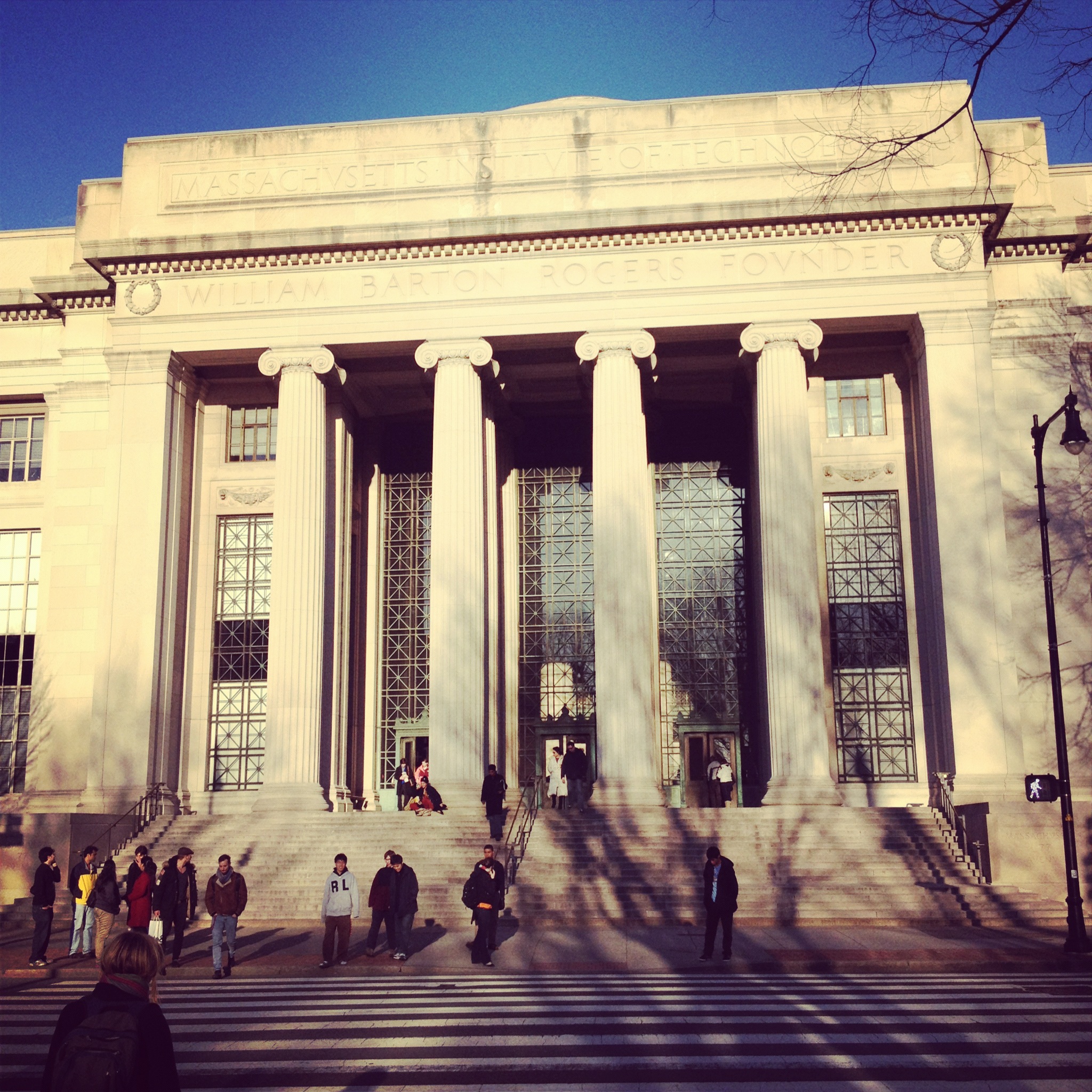
Whether you’re a freshman or a faculty-director, anybody can approach everybody at MIT for a serious discussion. People are not judged on their seniority, but on their true merit (ideas, discipline and skills). Upon entering a conversation, more senior MIT faculty will assume you have seriously thought about what you’re proposing, even if you’ve just entered MIT a week ago.
This leads to a healthy knowledge exchange system, where feedback and improvement suggestions are valued irrespective of their source and innovative ideas are celebrated.
At my home university, TUDelft, most students are expected to spend 5 years — most often more — analyzing complex problems. Designing and building practical solutions is something few students outside the Industrial Design & Architecture faculties find the opportunity to do. “Practical work” — the idea of a Polytechnic school — is something European engineering schools look down upon, and I believe this is a fundamentally flawed perspective considering the needs of society.
At MIT, students are expected to be able to build things with their hands. In the past two weeks, I’ve met MIT students who’ve built biodiesel production units; engineered dress shirts or created energy generating shock absorbers. I have made friends with people who developed software applications to teach children how to read; built electric vehicles half the size of a Smart for use in future cities and girls who’ve manually constructed their own computers.
Of course, within MIT there are some faculties which are particularly good at fostering development 0f these skills (such as the D-lab and the Medialab), but the “builder” characteristic is something I’ve observed in the majority of undergraduates and masters students at MIT. By creating a culture of “let’s prototype a solution, and see how it works”, students are ready to tackle real-world solutions when they graduate and they leave with the healthy framework of rapid prototyping.
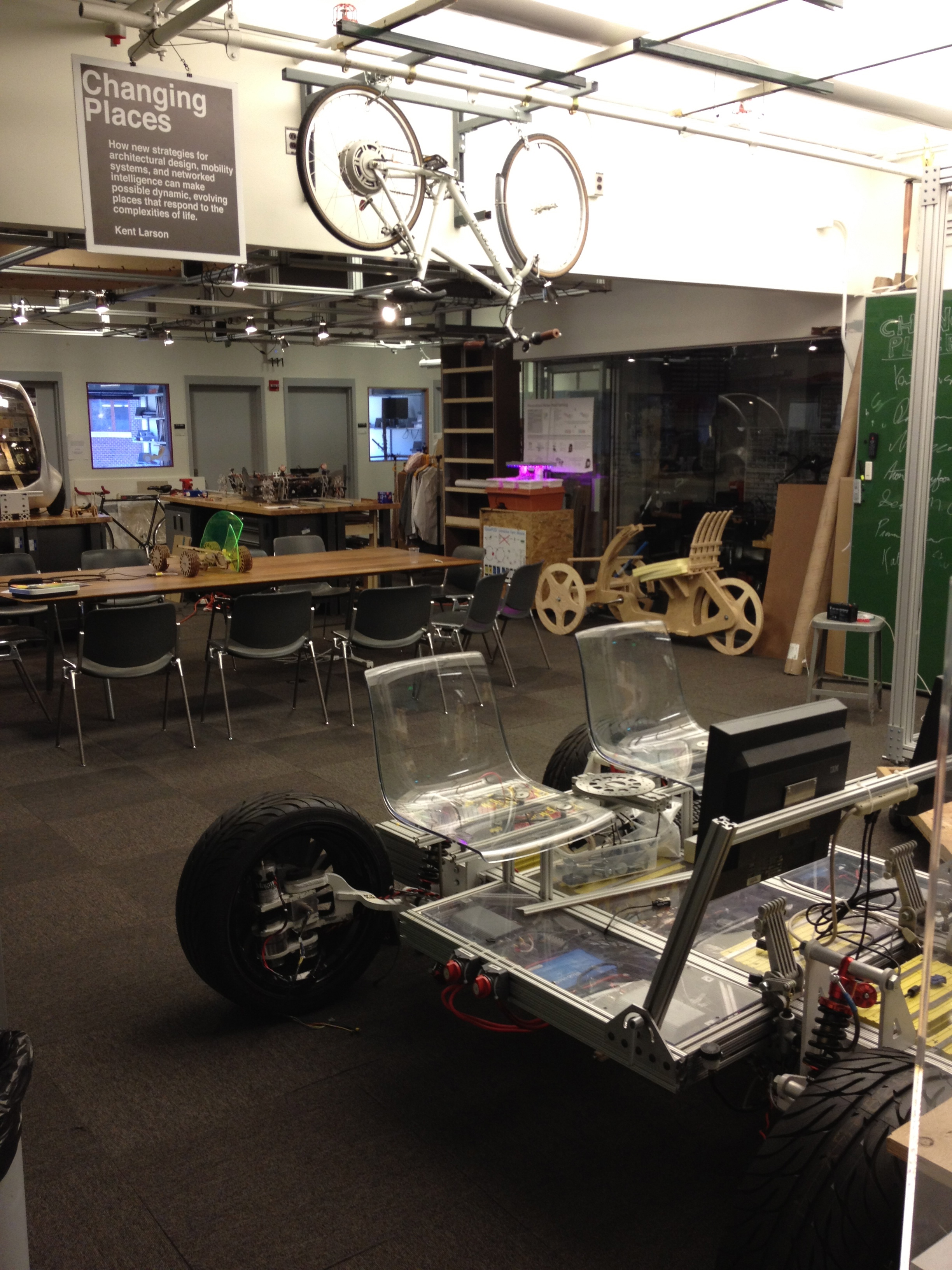
Related to the open culture, is the autonomy of professors, post-docs and others to research what fascinates them. Rather than having a top-down structure that subscribes people what to look into, there is a freedom of choice.
Because the quality of the people at MIT is superb, this leads to a very interesting set of research areas. At the MIT Medialab for example, approximately 30 research groups have come into existence, with names as Lifelong Kindergarten, Tangible Media and Viral Spaces.
Since arriving at MIT, this has given me the fundamental feeling that whereas most engineering schools look at the problems of the present, MIT’s research focuses on the problems of the future: looking a decade — or significantly longer — into the future of society.
In the American undergraduate system, engineering students spend the first year-and-a-half taking a diverse set of courses, ranging from physics and math to humanities and biology. Only after immersing themselves in a large set of courses, are students required to choose a major for the remaining two-and-a-half years – and during that time they are still expected to continue exploring their interests in all directions.
So far, these MIT-characteristics have given me the feeling that the engineers who graduate here are ready to bring improvement to the world, and that they leave their Institute with a well-founded background and a toolbox filled with useful skills. I am sure the aspects discussed above are not exhaustive, so please add your personal views below.

On my flight to NYC, I saw the movie Moneyball. Brad Pitt plays Billy Beane, the coach of the Oakland Athletics — a small-budget baseball team from the mayor league — who faces the problem that his best players are acquired by wealthier teams. He wants to show that great teams can be built without great budgets, and applies a radically different strategy. The core theme of the movie is fighting against the resistance that appears when you set out to change business-as-usual.
Although the new strategy leads the Oakland Athletics to achieve an unprecedented number of wins-in-a-row, Billy Beane is ultimately unsuccessful – the Oakland A’s do not win the championship. The movie triggered me to raise an important question: What is it that makes people accomplish their goals?
The first obvious part is “What is it you want to accomplish?”. It’s the basis for Stephen Covey’s second principle of highly effective people: “Start with the end in mind”. He phrases the quote “all things are created twice”. There is a first, conceptual creation, which is sometimes followed by a second, real-world creation – execution. If we want to be effective in our lives, it is fundamental to fully understand that we are the designers, and it’s up to us sketch our lives before we play them out.
But given there is a small percentage of people who know where they want to go, what is it that separates those who succeed from those who do not? Some of my thoughts below.
Be focused on what you want to accomplish.
Know where you’re going. Really, this is another way of phrasing Covey’s second habit. Bill Clinton was attributed to know from a young age that his goal was to become a governor. If you’re so focused, you can be very effective in implementing. Focusing on what you want to accomplish, however, does not mean you need to work in one field to succeed. Clayton Christensen shows in the Innovator’s DNA that innovation comes from relational thinking – being able to combine many fields.
If you do not know exactly where you want to go, focus fully on one of the possible fields that has your interest. Diverging your energy into many different activities often leads to mediocre performance in all. By putting all you energy into one direction, you will create significant process, and through reflection will be able to find whether you enjoy the field or not. The future holds many different paths.
Set audacious goals.
Setting audacious goals does not mean only big or difficult, but it means setting your mind on goals you define as truly meaningful. Picking mediocre goals is a barrier to greatness. It’s very hard to mobilize yourself, let alone others, by aspiring insignificant things.
Do the hard things; eliminate the easy things.
This is another way of saying: do the important things (which you might fear) and eliminating insignificant activities. This is an important reason why few people are successful: it is difficult to feel the fear and do it anyway. Rather, we succumb to the fear and check our email (seldom important) in stead of making that call. Worth noting, accomplishing things you fear is one of the biggest intrinsic rewards you can experience. This rule is very much applicable to everyday life. Try to reflect each day by asking yourself “what was the most important thing I did today?”.
Learn to think for yourself.
This is difficult because in the current educational system we have been un-trained to do so. A habit to think for yourself, questioning others’ opinions and using your own observational skills leads you to form new ideas and approaches to solve problems and make decisions. Ray Dalio, founder of Bridgewater, states this is the most important reason for his success in his investment career. Read his article on Principles here. Joi Ito, director of the MIT Medialab, phrased it eloquently in a lecture yesterday “you won’t win a Nobel prize by doing what others tell you to do”.

Eliminate pride. It’s not about you – but about your work.
Many people want to get famous. It’s flattering if you’re invited to speak, you’re asked for an interview, or if people want to meet you. But does it really matter? In the end, it’s all about the difference you make in other’s peoples lives. If you do this by meeting others, than that’s fine, because it’s your work. But be critical: if you’re a healthcare-entrepreneur, you should probably be speaking to potential customers or testing your product in stead of having coffee with people who go after your fame.

What an amazing place to be…!
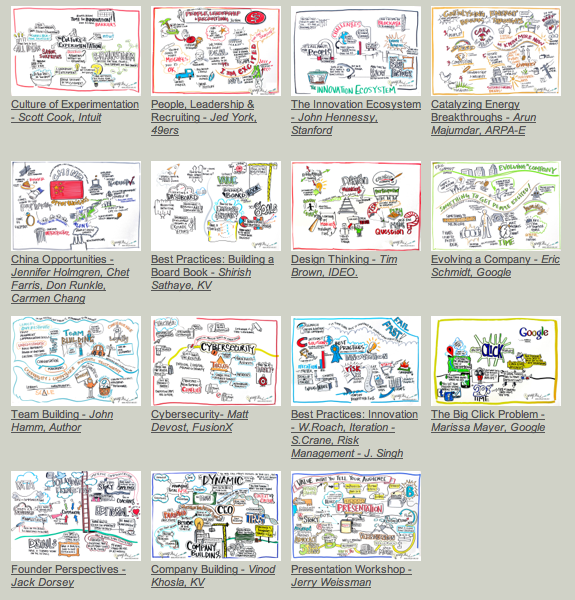
When looking at Vinod Khosla’s portfolio recently – I’m selecting my MSc thesis topic in Sustainable Energy, trying to identify research areas with commercial application – I came across a tab on his site named “entrepreneurial resources”. Right there was a bunch of video’s of Silicon Valley entrepreneurs, investors and designers that would make TED’s global homepage look rather bleak. Apparently, mr. Khosla organizes a private conference for the CEO’s of his portfolio companies.
The video of John Hennessy (president of Stanford) on the Innovation Ecosystem is particularly interesting – check out all others here: http://www.khoslaventures.com/khosla/entrepreneurial_2011.html
 Titiaan Palazzi Blog