Unknown's avatar

Reviving Buckminster Fuller’s last-designed Dome

Biodome picture

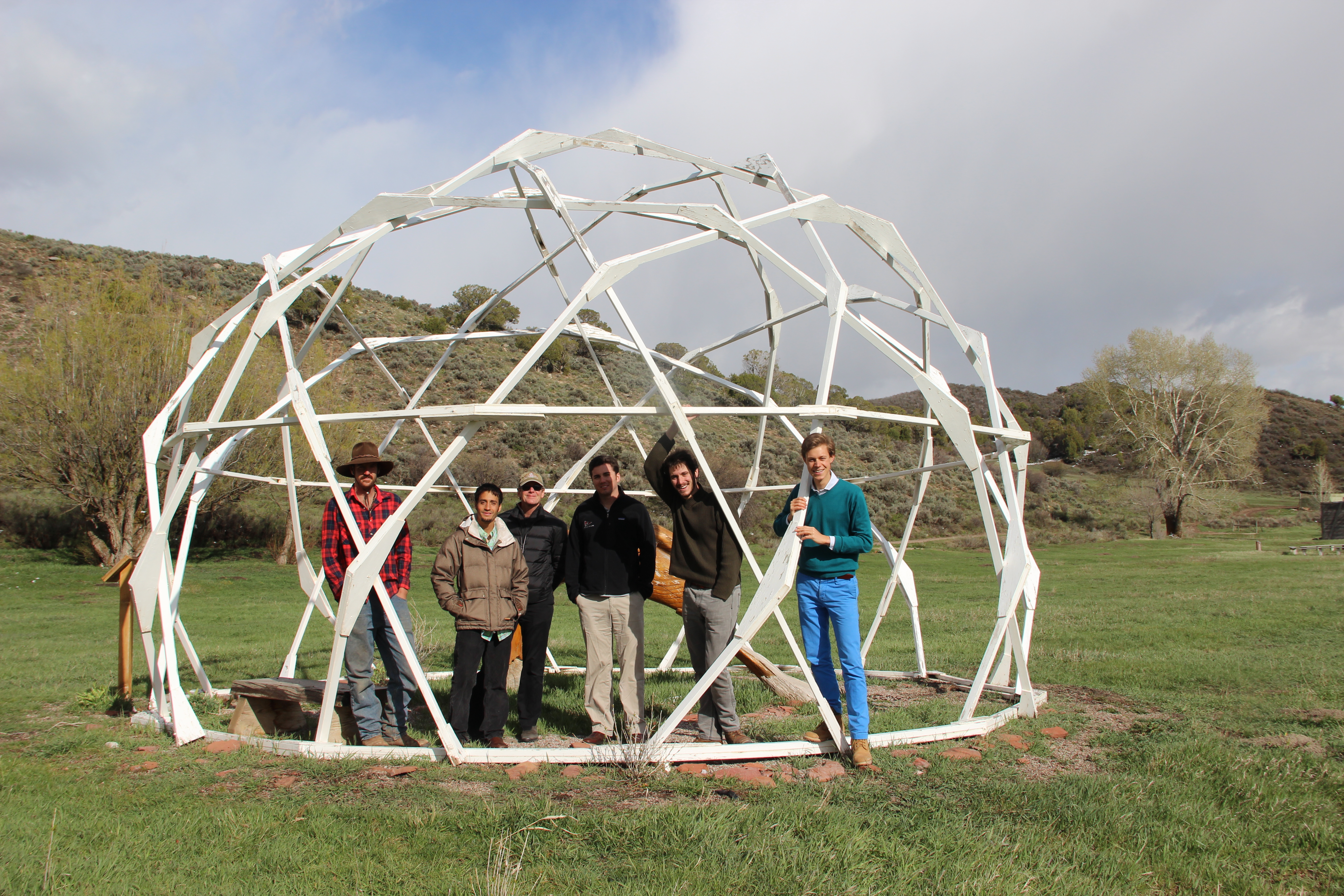
Paul, Eden, Michael, Robbie, Dan, and Titiaan inside the Windstar dome

In 1982, Buckminster Fuller led a workshop exploring geodesics and other topics. From that workshop, the idea arose to build a biodome on John Denver’s Windstar estate in Old Snowmass, Colorado. In the summer of 1983, weeks before construction was scheduled to start, Bucky died of a heart-attack. In his spirit, a group of young architects and engineers including Bill Browning and John Katzenberger built the Windstar biodome.

Biodome Windstar

The original 1983-built 5m-diameter biodome

The goal of the biodome project was to produce food locally year-round in a cold climate with solar energy. The dome was glazed with two layers of plastic film separated by an air space. Until the late eighties, the biodome was used to grow a variety of vegetables and fruit. The dome was separated into two levels, the lower level including a pond in which fish were raised, which doubled as a heat storage medium. An army of volunteers was involved to maintain the indoor (and outdoor) gardens. Today, only a structure and many stories are left.
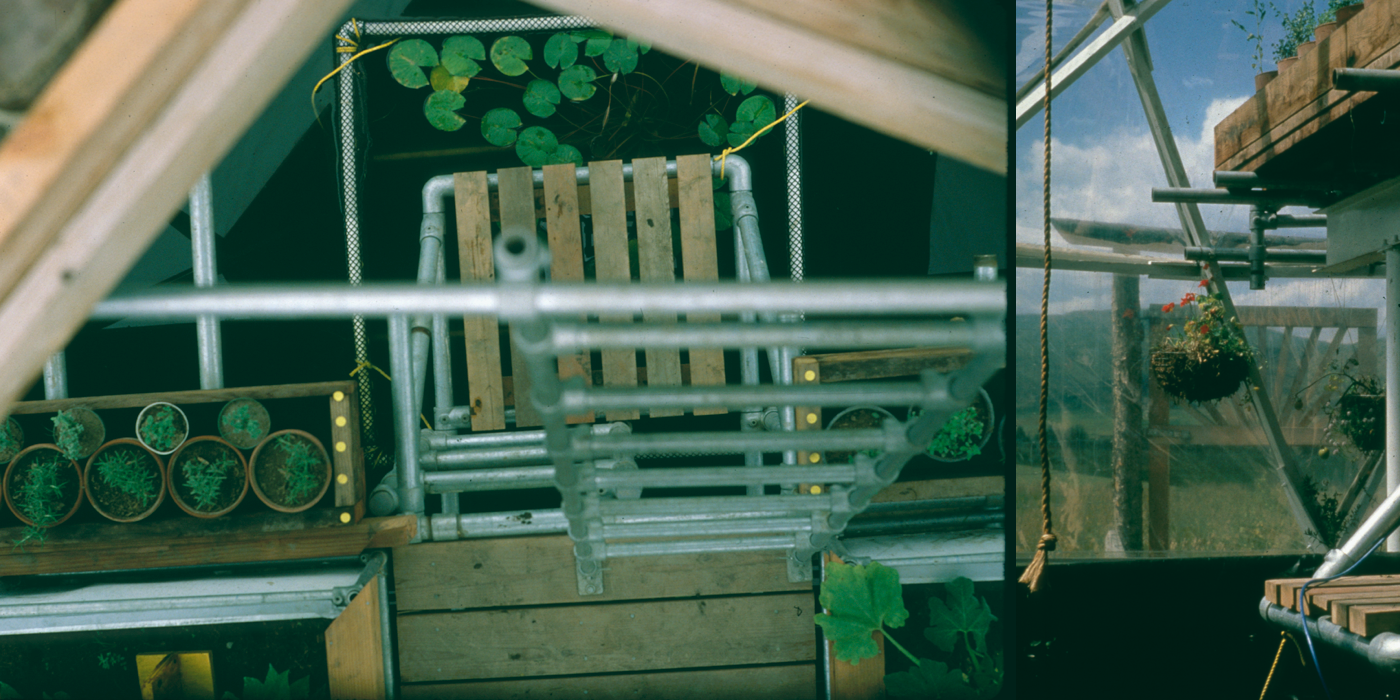
PlantsDome.001

Inside of the biodome: showing multiple floors and hanging gardens

When I arrived at Windstar three months ago and saw the dome, I knew immediately that I wanted to restore this legendary structure. Imagine re-building the last dome Buckminster Fuller designed! I soon learnt that I was not the only person excited about this prospect. Eden Vardy, founder of Aspen Tree, an NGO that aims to connect people to nature through agricultural training, had a similar idea. In fact, Eden and Aspen Tree’s co-director Paul, had erected another biodome close to Aspen in the fall of 2013. After Amory introduced us, it was evident we had to team up.

How to make this idea work? The first step was to develop design alternatives. Eden and I convened eight people—Greg Rucks, Dan Wetzel, Robert McIntosh, Garrett Fitzgerald and myself (all from Rocky Mountain Institute), Eden Vardy and Paul Huttenhower (both from Aspen Tree), and Michael Thompson, an architect with experience in designing grow houses—to participate a design charrette, a process to develop design alternatives.

The first goal of the charrette was to brainstorm design alternatives to glaze or skin the dome. We started the process outside, gathering all participants under the 5m-diameter dome (picture at top of this post), to be inspired by the dome’s history and understand the technical details of the current structure. After sharing stories about the biodome’s original state, we moved inside to start the charrette.

In the next hour, we generated many interesting ideas—building an opaque dome to use for mushroom-growth; using old parachutes as inside insulation; and building a fly-eye dome—and consequently selected four ideas to further develop. The group split into four pairs, each pair given the task to develop a list of materials and next steps per design alternative.
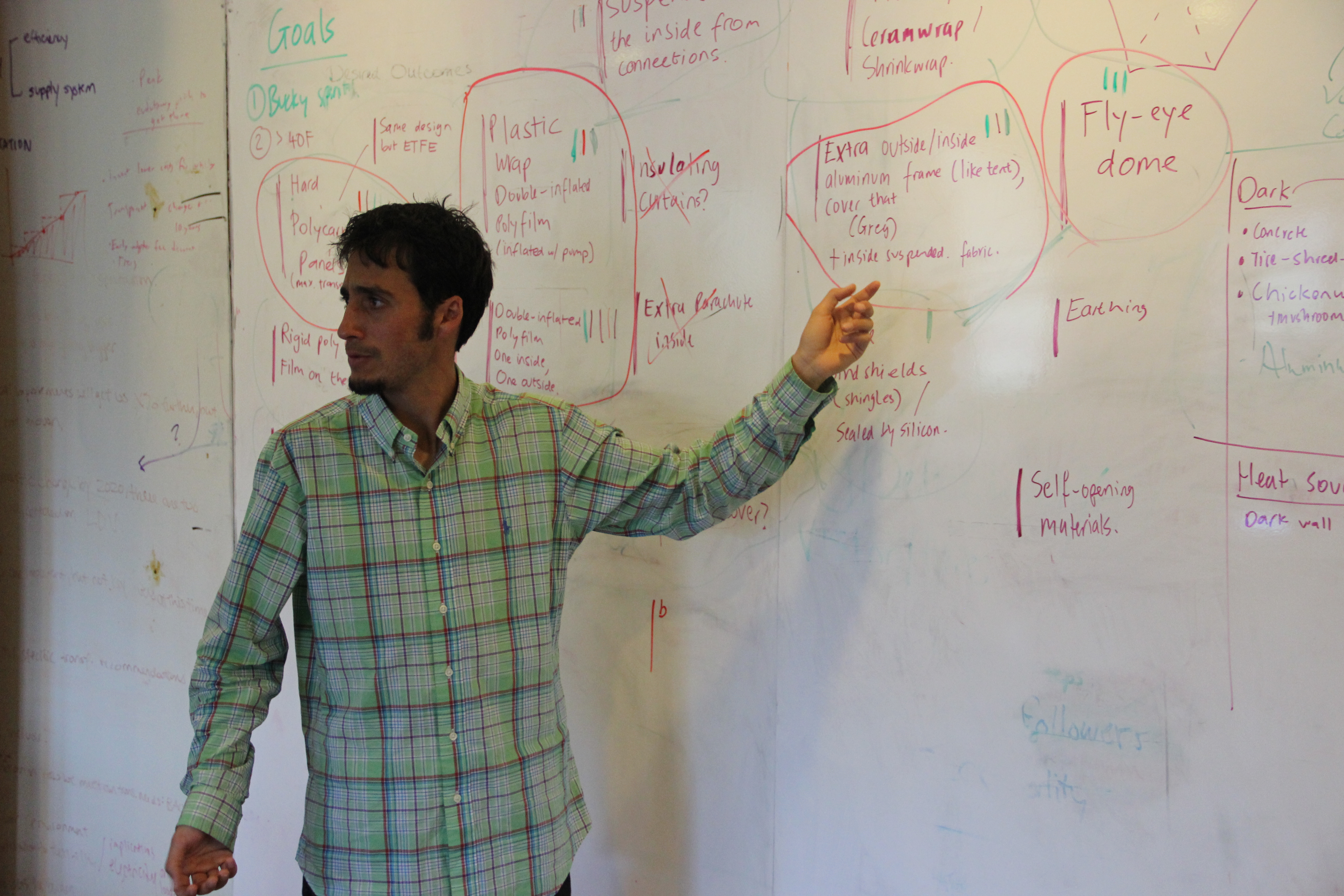
Overview of generated ideas

Eden guiding the selection of four ideas from the charrette to further develop

Four design alternatives were further developed:

1. Hard polycarbonate dome. The current structure is a “basket weave”-dome. As in a woven basket, the ribs alternatively pass concentric or eccentric of one another.  This means there is no flat plane to which to adjust all three sides of a triangle or five sides of a pentagon. Paul suggested a way to fix this by adding plywood to the joints, but the group questioned whether that was in line with Buckminster Fuller’s idea of ephemerilization—doing ever more with fewer pounds of material. Michael estimated that the material costs for the polycarbonate were ~$4,200 for a ~1200 square feet surface area (at $3.50/square foot), or double that if the parts were to be ordered pre-cut.

2. Double-inflated polyfilm dome. This was the design of the original dome (second picture in this post). In 1983, the intention was to perfectly seal the space between the plastic films and fill the space with a gas with a low heat transfer coefficient. The inserted gas between the films quickly leaked out, so an airpump was installed to inflate the “pillows”.  The benefit of this idea would be that few to no more material needs to be added to the structure of the dome. Michael estimated that the material cost for the double-inflated polyfilm would be $1,000 for the dome (at $0.75/square foot).

3. Extra external or internal structure. Greg and Robbie worked on the idea of adding an additional light structure around the outside of the dome, inspired by aluminum tent-poles, over which a permanent or temporary insulating material could be draped. The idea arose of a slinky-type external cover, made of aluminum or carbon fibre ribs and an insulating fabric, that can be pulled across the dome during the night. Michael suggested that an internal additional structure could be a better idea, given high snow loads in Aspen.

4. Fly-eye dome. Dan and Paul explored the idea of creating a fly-eye dome. This type of design would need much material compared to the three designs discussed above. Garrett accordingly asked what the primary goal of the fly-eye dome would be, to which the group agreed that the function was mostly aesthetical.

Whiteboard voting

Michael, Greg, and Robbie voting for ideas.

Reflecting on the charrette, it is most likely we will implement the double-inflated polyfilm dome, possibly with an additional internal structure as developed by Robbie and Greg. The benefits of this design are low material costs, identical appearance as the original, and quick installation.

The next critical steps for the projects are to raise funding for construction materials and to apply for a building permit. If you are interested to help during construction of the dome, please comment on this post.

Dome pattern

Structure of the dome. Note the “basket weave” of the ribs—each rib alternates between passing concentrically or eccentrically by other ribs.

Unknown's avatar

What do you think about—and why?

Canada Goose

Do you pay attention to the sounds of geese swerving overhead? I never did, but that recently changed, as I saw the documentary Winged Migration: a beautifully filmed narrative, portraying the extensive journeys of migratory birds*. Since seeing Winged Migration I notice that I pay more attention to songs and appearances of birds.

Do you ever think about what keeps buildings cool? I had thought about building cooling principles, but never observed the devices that created the cooling. That changed in 2012, when I spent one week categorizing rooftop-installed cooling equipment on office buildings in Massachusetts. Spending several hours per day studying rooftops on satellite images, I started to notice cooling units on buildings everywhere: from the window of my morning bus-ride; during walks around Harvard square; even as I landed in Florida for a connecting flight to Costa Rica. My attention was triggered.

When your brain is made aware of something—be it migratory patterns of birds or rooftop-cooling units—it pays more attention to this object of phenomenon. Our awareness is influenced by what our brain has been processing. In other words: what we notice is influenced by previous mental exposure; there is a relationship between past, present and future. If you want to control what you think about, your task is to feed relevant and sticky input to your brain. Relevant because the input must relate to what you want to think about (if you want to learn about databases, reading Hamlet is unlikely to be the most effective way); sticky because the brain responds differently to different types of information (compare the mental impact of reading about the salty flavor of an oyster to the mental impact of tasting an oyster).

Time for a question: What do you think about?

Look away from your computer screen for a minute. Meditate upon your thoughts in the last hours, slowly expanding the scope to your thoughts the last days. Write down the types of mental activity you were engaged in, such as technical (how do I code this loop?), logistics (what groceries should I buy?), planning (what do I want to do today?), relationships (who do I want to see this week?), reading, or marketing (how do we get people to buy this?).

I asked this question to several friends on my visit to San Francisco last week. Pieter Verhoeven and I created a short list, sitting in Steve Jobs’ favorite Japanese restaurant in Palo Alto.

  • Technical / calculations (work)
  • Technical / problem-solving approach (work)
  • Conversations with people
  • Sleep
  • Relationships (who to call, who to spend time with etc.)
  • Logistics (shopping, rent, tax etc.)
  • Personal future
  • Non-personal future (sensors and actuators, artificial intelligence, energy systems etc.)
  • Technical / creating (drawing, programming, making physical objects etc.)
  • Nothing (meditation?)
  • Sleep
  • Dance or music
  • (Surprisingly, eating as a mental activity was not one of them—Pieter and I both noticed that we are normally engaged in conversation or work during meals. To be changed.)

I noticed that I think much about people. I spend at least one hour per day asking myself questions as “Who do I want to speak to in the office?” “Who can help me realize this idea?” “To whom have I not spoken in a long time?” Until last week, I had not questioned that type of thought—I just accepted that I thought about people. By comparing my categorized thoughts to those of friends, I realized I spent more time thinking about people than most.

Returning to the hypothesis that your thinking is influenced by the things you feed your brain, my thoughts about people are likely induced first by the fact that I make lists of people I want to collaborate with—a stimulus for the brain; second by the fact that I have enforced that mental activity; and third because I actively spend time learning about people’s stories: reading people’s blogs, calling friends, reading biographies—another stimulus for the brain. In addition, people’s stories are sticky (at least to my brain)—I find it fairly easy to remember the experiences friends tell me about, even years after their telling.

I want to improve my technical mind by deeply understanding models from chemistry, physics and biology. I do this today by picking up science books, by watching documentaries, and by visiting research labs of friends who have decided to pursue a PhD. Interestingly; I notice that some activities are much stickier than others. Feynman’s Six Easy Pieces led to many new ideas; and so did spending two hours peaking at fruitflies through a microscope with Didem Sarikaya at Harvard’s Department of Biology. The book I picked up about chemistry did not have that same stickiness.

What do you think about? What is the cause of this? What do you want to think more, or more actively, about? What stimuli can you use to foster that thinking?

###

My dear friend Jan Overgoor shared with me a vivid example of an experience triggering the mind. Lately, Jan has worked on different projects with wood, including the construction of a beautiful elliptical tabletop for his home in Berkeley. Jan informed me that he is much more aware of the touch of different surfaces since working actively wood, automatically comparing surface he touches to the smoothness and softness of wood.

*Since seeing Winged Migration, I have a new favorite animal: the Arctic Tern. Why? This little bird travels on average 95,000 kilometers per year. That is more than double the circumference of the earth. If we assume an Arctic Tern flies 300 days per year, the average daily travel is more than 300 kilometers—all by muscle power, no oil needed, nor snacks. What a globetrotter!

Arctic Tern

Unknown's avatar

Leverage Points for a Better World

RMI's office in Snowmass, close to Aspen—the former estate of John Denver.

RMI’s office in Snowmass, close to Aspen: the former estate of John Denver.

I moved to Snowmass, Colorado two weeks ago to work directly with Amory Lovins, cofounder, Chairman and Chief-Scientist of the Rocky Mountain Institute (RMI). RMI is a think-and-do-tank that aims to drive a world verdant, safe, and secure by developing  solutions in collaboration with for-profit enterprise in the areas of more comfortable and  efficient buildings; more productive and reliable industrial processes; and safer, better transportation systems.

A tool we aim to exercise at RMI is “Institutional Acupuncture”—sticking metaphorical needles into carefully chosen points in complex organizations and relationships to get the business logic flowing properly in the channels and directions it already naturally flows.

What does “Institutional Acupuncture” mean in practice? What blockages do we try to eliminate today? In the last two weeks I have spent much of my time asking questions and listening to my new colleagues. Below is a list of topics that represent we engage in today.

#1. New utility business models

The availability of ever-cheaper distributed generation technologies—such as the solar panels on your roof—begs the question: “Do I require a utility-contract for my power? Is it not cheaper, more reliable, and cleaner to privately power my home?”

This query is addressed in two publications by eLab: a program to unite decision makers and thought leaders to identify, test, and spread practical innovations to key barriers slowing the transformation of the U.S. electricity system. The first analysis, “Grid Optional“, is written for private citizens. The publication shows by which year investing in solar-and-batteries and defecting from the grid is cheaper than maintaining an agreement with a utility.   

The second analysis from eLab provides utilities with future scenarios. The publication is appropriately titled “New Business Models for the Distribution Edge”. David Crane, CEO of NRG Energy recently wrote an article about the death of utilities as we know them today, as did Amory on RMI’s blog.

 #2. Lowering the costs of solar PV

Lowering the cost of electricity from solar panels below the cost of electricity from other sources is a major driver for a high penetration of renewable energy. Although the cost of a solar panel is now five times cheaper than in 2000 , installation costs of a solar panel system are twice as high in the U.S. as in Germany or Australia. In collaboration with NREL, RMI’s Dan Seif and Jesse Morris have published a report to show how these soft costs—installation labor, financing and marketing costs for instance—can be lowered, introduced in this article.

When you  consider installing solar panels—or have done so already—it is valuable to understand the benefits and costs other than electricity savings from your system, qualified in this article by Lena Hansen and Virginia Lacy. 

#3. Reducing energy consumption in (groups of) buildings

RMI saved 30% of energy consumption in the Empire State Building by replacing 6,154 windows onsite on the 5th floor. This  is one of RMI’s most celebrated stories, and a good example of the value from deep energy retrofits beyond cost savings. Our physical environment is a critical place to invest in: buildings use three-fourths of U.S. electricity. If America’s 120 million buildings were a country, it would rank third in absolute energy use, only eclipsed by the energy consumption of China and the entire United States.

The Retrofit Challenge, part of RMI’s buildings sector, aims to implement deep energy efficiency solutions across a large volume of buildings. To reduce the costs of energy modeling of each individual building, we define building archetypes:  groups of buildings with similar energy use. AT&T is our first client in the Retrofit Challenge.

#4. Helping China get off oil, coal and natural gas profitably by 2050

After Reinventing Fire was published in 2011 a collaboration with the Chinese NDRC was initiated to translate the quantitative analysis of Reinventing Fire for the Chinese context. In collaboration with Lawrence Berkeley National Labs and China’s Energy Research Institute, the implementation of the strategies and policies outlined in Reinventing Fire is one of our key priorities. Since China is now the world’s largest market for private cars and has the highest volume of electricity generated from coal, our work with the NDRC is a key leverage point in reducing global greenhouse gas emissions.

#5. Uniting U.S. and Chinese automakers to lightweight and electrify vehicles. 

Project Get Ready was a big RMI initiative to push the adoption of electric vehicles by helping local U.S. communities learn from best practices outside America and install charging stations. Combined with RMI’s earlier work on light weighting—which led to the Hypercar design, the design philosophy on which BMW’s i3 is based—RMI is organizing a forum to bring American and Chinese automakers together.

Which other leverage points can we solve?

The list above does not exhaust RMI’s work. We started an initiative for sustainable islands with the Carbon War Room on Richard Branson’s Necker Island last month; we are planning an initiative to work with manufacturers to create more energy-efficient products.

Which leverage points do you see to work with business to get to a world in which people feel productive, happy, and safe, powered without the need of burning historic bank accounts of fossil-fuel cash?

###

The idea of Institutional Acupuncture is closely related to systems change. A beautiful example revealing the complexities of systems change in a natural ecosystem is the introduction of wolves in Yellowstone Park. Watch it—you will be amazed and delighted.

Unknown's avatar

Medialab in Mumbai

MIT performance capture group

I returned yesterday from Mumbai to Amsterdam. I had the honour of being one of the teachers at the MIT Medialab India Initiative. We brought together 350 Indian college students, with backgrounds in engineering and design, with the goal to design and build solutions for a better (Indian) future. It was without doubt the most rewarding teaching experience I have ever had. Why?

There was no competition between student groups (in fact, computer science students from one group would regularly sit for an hour with another group who had no coders); all students were fully engaged in participation; every single student tried things he had never done before (from programming an arduino to printing a PCB); and we had so much fun.

In fact, I was able to learn new things myself: how to build a circuit with no other materials than paper, copper wire, a battery and an LED; how to solder and how to get a group of 20 young males to dance.

The 34 students in my group created 8 prototypes within 2 days of building. See the presentation below, and be inspired.

###

If you’re interested in how the workshop was led, please reach out for the curriculum.

Unknown's avatar

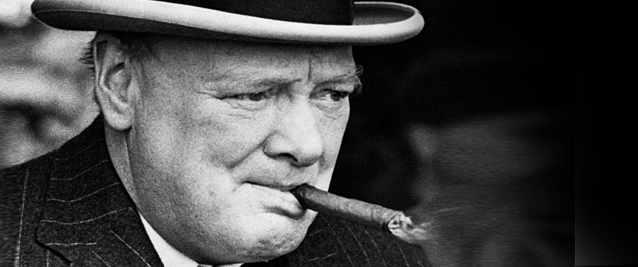
6 lessons from Churchill’s biography

Churchill

Churchill is widely admired for his courage and leadership. Would you not want to read about a man who is described by a biographer (Paul Johnson) as follows: 

Of all the towering figures of the twentieth century, both good and evil, Winston Churchill was the most valuable to humanity, and also the most likable. […] None hold more lessons, […] How to seize eagerly on all opportunities, physical, moral and intellectual. How to dare greatly, to reinforce success, and to put the inevitable failures behind you. And how, while pursuing vaulting ambition with energy and relish, to cultivate also friendship, generosity, compassion and decency.

Here are 6 lessons on life from Churchill’s biography:

Dedicate yourself fully to an activity. As a teenager Churchill discovered that he had a love for words. Attracted by the adventure of joining battles, Churchill decided to try to report on a war in India. Spending most of his twenties traveling all around the world reporting from the front lines, war-reporting became Churchill’s obsession (paraphrasing Drew Houston, Churchill found his tennis ball). Later Churchill would throw himself with comparable vigour into other activities.

Build different ways to express yourself. “Politics never occupied his whole attention and energies. He had an astonishing range of activities to provide him with relief, exercise, thrills, fun and money.”

Churchill was dismissed from his position as Admiral in the British navy by prime minister Asquith at the start of WW1. Churchill found himself suddenly with no daily responsibilities, which had a disastrous effect on his mental state (his wife thought “he would die of grief”). Inspired by a friend, Churchill picked up painting. Painting became a deep passion, since “while you are painting you can think of nothing else.” I think it is critical to develop activities that you enjoy outside your work – all the more so in a future where fewer people have jobs. In what ways do you express yourself? 

Go where the action is. “Churchill began his plan of campaign to make himself famous, or at least conspicuous. But if you sat still, expecting wars to come to you, you might be starved of action. You had to go to the wars. That became Churchill’s policy.”

Churchill built up a reputation by fighting in the front lines – he did not stay in the UK. After returning from his war journeys, he quickly built a network in London with people in the House of Commons, as his aspirations were to become a politician.  “All his life he refused to be bound to a desk. He insisted on seeing for himself.”

Rise after you fall. Churchill was fired from his official position more than three times and lost many personal battles (he lost all his money on multiple occasions). Yet he never let his head hang (for too long). After he was dismissed as Admiral of the Navy, he found a way to participate in a battle on land. He was humiliated badly in the House of Commons but fought his way back into politics.

Do not take yourself to seriously. “We are all worms. But I really think I am a glow worm.”

Share your work. “This was his first book, and he sent a copy to the Prince of Wales, who wrote him a delightful letter of thanks, praised it to the skies, and recommended it to all his friends.”

Unknown's avatar

What is your steady state?

I wrote this article in March 2013 after visiting friends in San Francisco. Over lunch in Bangalore, I had a discussion with friends about the things they do in moments of free time. I remembered my idea of “steady state activities”, and wanted to share my reflections at the time. 

Imagine that next week miraculously has 8 days in stead of 7. How will you spend your extra day?

In our free time we tend to default to a limited set of activities. When a day of work is cancelled we pick up a book, invite friends for dinner, or jam on our guitar. I call the set of activities we resort to in times of tranquility – our side projects, our hobbies – our steady state. 

Why is it important to know our steady-state? Because our precious “free” moments are perfect opportunities to do things we love. If you are not conscious of your free time, it is easy to default to “urgent”, unimportant activities: answering email, glancing at newspaper headlines.

“We are here on Earth to fart around. Don’t let anybody tell you any different.”

– Kurt Vonnegut

Your steady state can bring you new perspectives. My friend and great designer Carson regularly visits museums, to study how human organizations have evolved in recent millennia. Maricarmen, entrepreneur and yoga teacher, finds herself dancing to powerful music in her mornings, to energize her body for studying and writing. Eric runs out of the building whenever he has moments to spare on his Kauffman trip, to capture the world from a different perspective through his camera, improving his skill as a photographer.

These are beautiful and constructive steady state activities. They bring joy and inspiration to my friends. They allow them to be more productive in their work. And, over time, these steady-state activities work like compound interest: by spending a bit of time every week, these side projects may one day form the basis of their next big thing.

###

What do you do on a free afternoon? Can you share an example of a skill you built up incrementally on the side over the years? 

Unknown's avatar

Rapid Prototyping by Orangutans … and other reflections on three days in Kalimantan

Matt, Casper, Caroline and Titiaan

Casper invited me to spend a week with our good friend Caroline and his sister Laura at a primate-research project in Borneo, Indonesia. Casper’s friend Matt, the communications director of the Orangutan Tropical peatland project and avid wildlife photographer, had offered to host us. On December 31st 2013, I booked my flight from Bangalore to Kalimantan – starting the new year with an adventure inspired by this article.

It was a great decision. Orangutans are beautiful animals. At rest in the crown of the forest, they look similar to a man sitting in a tree, honoring the origin of their name: “person of the forest”. In their natural habitat they are solitary – orangutans live alone. They feed primarily on fruits and some leaves growing in the rainforest canopy. Males grow flanges (the big cheeks you recognize from pictures) when they start to get ready to reproduce. Few females in the animal kingdom are as dedicated to being a good mother: young Orangutans stay with their mother for 7 to 9 years before they gather their own food.

The Borneo Orangutan Survival foundation operates a rehabilitation centre where orphaned Orangutans are fed and nursed to go back into the wild. To get re-acquainted to living in natural forest, Orangutans spend months to years at the half-way stop, an island in a river where they can room around freely but still receive food. Every morning a boat drops bags full of vegetables and fruits at several feeding locations on the island’s banks. We were lucky to see this spectacle from a boat moored at a few meters distance.

Orangutan_Titiaan

Alfred making his canvas’ hammock

After one bag of ears of corn had been emptied, one of the Orangutans – let’s call him Alfred – showed us his inventiveness. Alfred ripped open the bag along one side and put it over his head a cape. Fed up with the cape, he put the canvas material under his armpit and climbed up a tree to show us some rapid prototyping skills. Alfred hang one side of the cape onto a branch and tried to crawl into the canvas bag to use it as a hammock.

Once he succeeded, preparing to take a nap, one of his friends came to claim his hierarchy by stealing the bag. Alfred was scared out of the tree, but his fellow Orangutan did not have the perseverance or curiosity to make a hammock out of the bag – it looked so much easier when his friend had done it – and threw the bag down into the river (as for humans, easy access to an object often seems to reduce the pleasure experienced of that object). Alfred climbed down immediately to fish the bag from the river, trying to make a hammock once again. A creative, persistent fellow.

Before visiting the BOS foundation, we spent two days in the natural forest with OUTrop. As Matt and I made our way through the forest on one of the morning walks (walking through knee-deep peat-swamp), we had a direct encounter with a young male Orangutan. Fully focused on eating fruits 10 meters up in a tree, the Orangutan did not notice Matt and me at first. As I cracked a branch, the Orangutan suddenly saw us. He looked us straight into the eyes, grabbed a branch above his head and snapped it from the tree. He held it threatingly above his head, and then threw it to the ground with his strong arms. Then, he aggressively swung his body to another tree and Matt and I left the site. It made a deep impression on me.

Orangutan_foret

Leaving Kalimantan tomorrow to meet with Willie Smits, the Orangutans have left a deep impression on me. They are peaceful animals, able to determine their own plan, not disturbed by the process of group decisions. I came to see the Orangutan as the “philosopher king” of the animal kingdom, not disturbed by trivial matters, peacefully exerting only the necessary effort, solitary contemplating the meaning of life (whilst chewing leaves) from a treetop.

When did you feel a deep connection to other animals?

Unknown's avatar

Bustling Bangalore

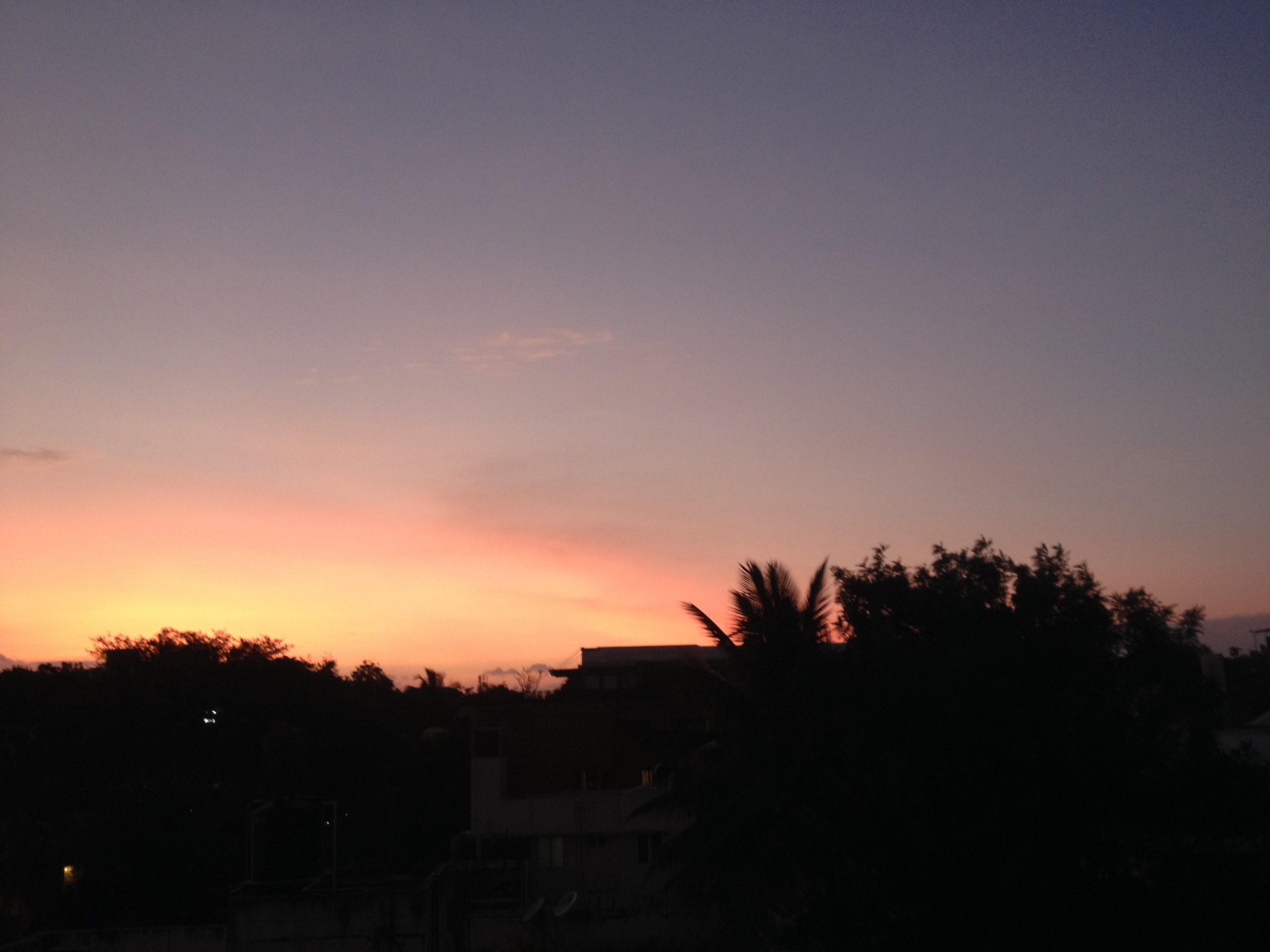
Sunset in Bangalore

Last week I arrived in Bangalore. After a thrilling week in India, I am glad I had the courage to book a last-minute flight to Bangalore once I was told that I had to wait for two more months for my U.S. working visa.

Adjusting to life in Bangalore is easy. Many speak English and tasty food is available on every street corner. Several great groups of people invited me to work with them, bringing meaning to my days in India from the moment I arrived. I stay with wonderful friends who double as great hosts. I go to sleep every night having learnt at least three new things.

Buildings, infrastructure and transportation

Buildings shoot from the ground everywhere, although access to a proper home is unevenly distributed. The picture below shows a tent community in front of a newly erected building.

Building and slum

Bangalore’s streets are surprisingly clean, but waste’s final destination may be nearer than you think. I was surprised to discover this garden with integrated garbage dump one morning as I woke up to watch the sun rise from my roof terrace in Indira Nagar.

IMG_5967 

Transport in Bangalore is hectic. The first days I traveled by riksha (called “autos”, I actually drove one an auto last Sunday evening), but I quickly decided to test the public bus system. Boarding the bus on my first ride, I was surprised to see only women sitting! When I turned my head to look towards the rear of the bus, I realized that all men were sitting in the back. This is an unspoken rule I’ve observed on buses since, so that women have a place to sit. I wonder how it was first implemented.

Women in bus

Providing access to electricity to the poor

On Wednesday and Sunday I went out into Bangalore’s tent-communities (slums) with the wonderful fellows and interns of Pollinate Energy. Pollinate provides access to electricity to people who do not have access to the grid. They do this by recruiting entrepreneurial twenty-year-olds from local urban communities – called Pollinators – to sell products that people want: solar panels, lights integrated with mobile-phone chargers, cookstoves and possibly soon modular homes; tablets and low-voltage TVs.

I quickly learned that it is essential to work with local entrepreneurs if you are to sell products. When I enter a community – a European with blonde hair and white skin who speaks not a word of Kannada – it stirs up many reactions, yet these do not necessarily lead to an interest in the service we are trying to provide. The real value is created by someone the community can trust – a boy like Madu in the picture below, who gently explains the benefits of not using kerosene. What is important is that the community can trust the storyteller.

I also learned that people’s dis-interest in an electricity-providing product can have many more reasons than poor product design. In two days, I have heard people explain that they fear that the solar panel will be stolen; that neighbors will destroy the solar lantern; or that they simply do not want to be the first of their friends to buy the product.

Madu in tent camp

A little running

After Wednesday’s visit to the slum, Monique and Jamie from Pollinate invited me to participate in Bangalore’s midnight marathon run – the 10km version, not the original Greek length – on Saturday night. Dressed up as light-emitting bees (yellow shirts, black tights, LED-light strapped to our chest) more than twenty of completed the track in Whitefields – cheering and screaming to one another as we passed.

Bengaluru midnight marathon

I spent the last two days with Infosys’ Green Initiatives team. Under the leadership of Rohan Parikh, this group of 15 very competent engineers are committed to realizing the world’s most energy-efficient buildings. Since 2008 the team has reduced energy consumption in new buildings by almost 50%. My goal is to work with part of the team to realize a bold project in the next five weeks.

Sunset from the roof

Unknown's avatar

Achieve your dreams by studying failure

Even when you understand reality, things can go wrong.

Even when you understand reality, things can go wrong.

“Truth-more precisely, an accurate understanding of reality-is the essential foundation for producing good outcomes.”

Have you ever wondered with hindsight why a project failed, despite all your effort?

In “Principles”, Ray Dalio outlines how he thinks people can be more successful. The goal of his essay is to make a reader think (1) what she wants, (2) what is true and (3) what to do about this. As explained in the essay’s introduction, principles are ways of successfully dealing with the laws of nature or the laws of life. People who understand more principles well can take action more effectively.

This argument – by better understanding reality we can improve our performance – compels me. We let what we wish to be true stand in the way of what is true. In the last two months, I built a team for a summer program of a new higher education institute in Amsterdam, assuming that the institute would happily work with us. If the institute turns out not to want any external help, my misunderstanding of reality led to an unsuccessful project.

 “I believe that the way we make our dreams reality is by constantly engaging with reality in pursuit of our dreams and by using these encounters to learn more about reality itself and how to interact with it in order to get what we want.”

To improve my understanding of reality, I have used two methods. The first method aims to identify shortcomings and failures in past projects; the second aims to reduce failure in the future by writing down expected problems.

Method 1: learning from the past

Take time to reflect on your three most recent work experiences. Why did you start those projects, jobs or companies? In what sense were you successful? Where did you fail? Why did you fail?

I keep a “Learning Journal” on all projects I have started or joined. Below is one entry of my Learning Journal that reflects on Cool Schools. Read it to understand the questions I ask myself.

Learning Journal

How do you reflect on past failures or shortcomings in work? How do you keep “lessons” in sight, to avoid making a mistake multiple times? 

Method 2: anticipating the future

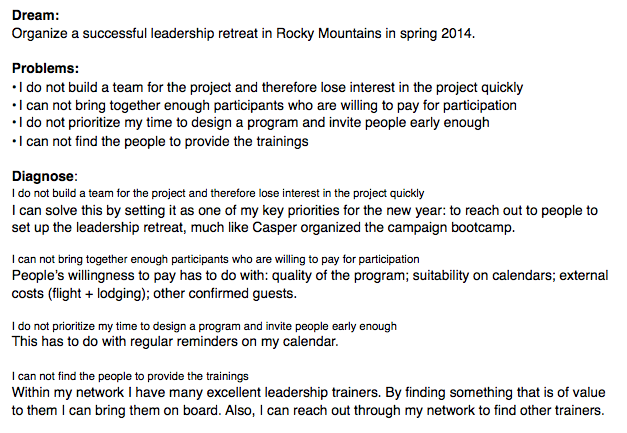
To reduce chances of future failure, anticipate your problems today. Ray Dalio suggests a 5-step process: write down your biggest goals; identify the problems that stand in the way of your goals; accurately diagnose the problem; design an action plan that gets you around the problem; execute.

Below are the first 3 steps for one of my dreams for the next year: to organize a leadership program for my dearest friends in the Rocky Mountains. I put it here not because the content is interesting, but so you have an idea of the first steps.

5 step process

What are your dreams? Do you have ways to keep in sight the potential deal-breakers? 

What do you think of these methods? Do you consider it a waste of time to think about problems ahead of time? Do you understand “reality” through intuition? Do you have ways of better understanding reality?

###

Like Ray Dalio’s style? Want to learn more about the economy? See this 31-minute video.

Unknown's avatar

Why are electric grids different than the internet?

Observation #1: Information is automatically stored; electricity is not

Digital information creation commonly includes storage. When you write an email or take a picture, the information you create is automatically stored in the recording device, in the cloud, or in a combination thereof. Because creation is paired to storage, information can be consumed at another time than it was produced. You don’t need to read a book as the author writes it.

For electricity, the story is different. When a flow of electrons is created it must be transported and consumed instantaneously. Today’s gas power plants or wind turbines – electricity generation devices – do not offer the possibility to store electricity for later use. Neither do fridges or microwaves – electricity consumption devices.

N.B. The notable exception to integration of information creation and storage are spoken conversations. When we chat, our voices are not automatically stored. (This is changing, though.) Non-digital forms of information – a written letter, a painting, a Beatles’ vinyl – are stored, but are not easily replicable (see the next observation).

Observation #2: Information can be copied; electricity can not

When you send me a postcard, I can read it once, ten times or a hundred times, without the quality or quantity of the information changing. The information can be viewed an infinite number of times. When you send me a digital postcard, not only can I read it infinitely, but others can read it an infinite number of times too. Digital information is endlessly replicable – its quality and quantity doesn’t change.

A quantity of energy can only be used once, much like a kg of gold can only be used once. The physical properties change when you use the electricity. But, gold can be reused. I can not conceive of ways to derive the services from electricity without using the electrons. This is a big difference to distribution of information.

Image

Scalability of electricity, versus scalability of information

You can visualize this difference by envisioning a ratio that equals the number of times something is used over the number of times something is created.

For electricity, the consuming versus creating ratio can be no larger than 1. Every kWh of electricity generated can only be used once (or less, if it’s wasted somewhere between generation and consumption).

For information, the consuming versus creating ratio can be much larger than 1. Every line of words typed by you can be viewed by a billion users, who read it hundreds of times.

Observation #3: Digital information can have an enormous variation in value; electricity can not

This may be the most important insight of this entire post. For a given quantity of digital information – say, 10MB of sound – the quality can range from terrible (the sound of a jetplane if your goal is to relax) to outstanding (a symphony orchestra recording for the same goal). The value for that piece of information can range from negative (I’d pay you to remove the sound) to very valuable (worth €10 per iTunes Album). Combined with digital information’s replicability (the previous observation), the large variation in value explains why software can be worth hundreds of dollars (Adobe Suite) or nothing.

In my view, electricity does not have a large distribution of value. For a given quantity of electricity, the quality is more or less equal. There can be a difference in value, depending on whether the electricity is generated close to the location of desired use or far away and whether electricity is generated according to the user’s preferences or not, but this value difference is marginal compared to the value difference of information – in the order of tens of percents.