Unknown's avatar

Reviving Buckminster Fuller’s last-designed Dome

Biodome picture

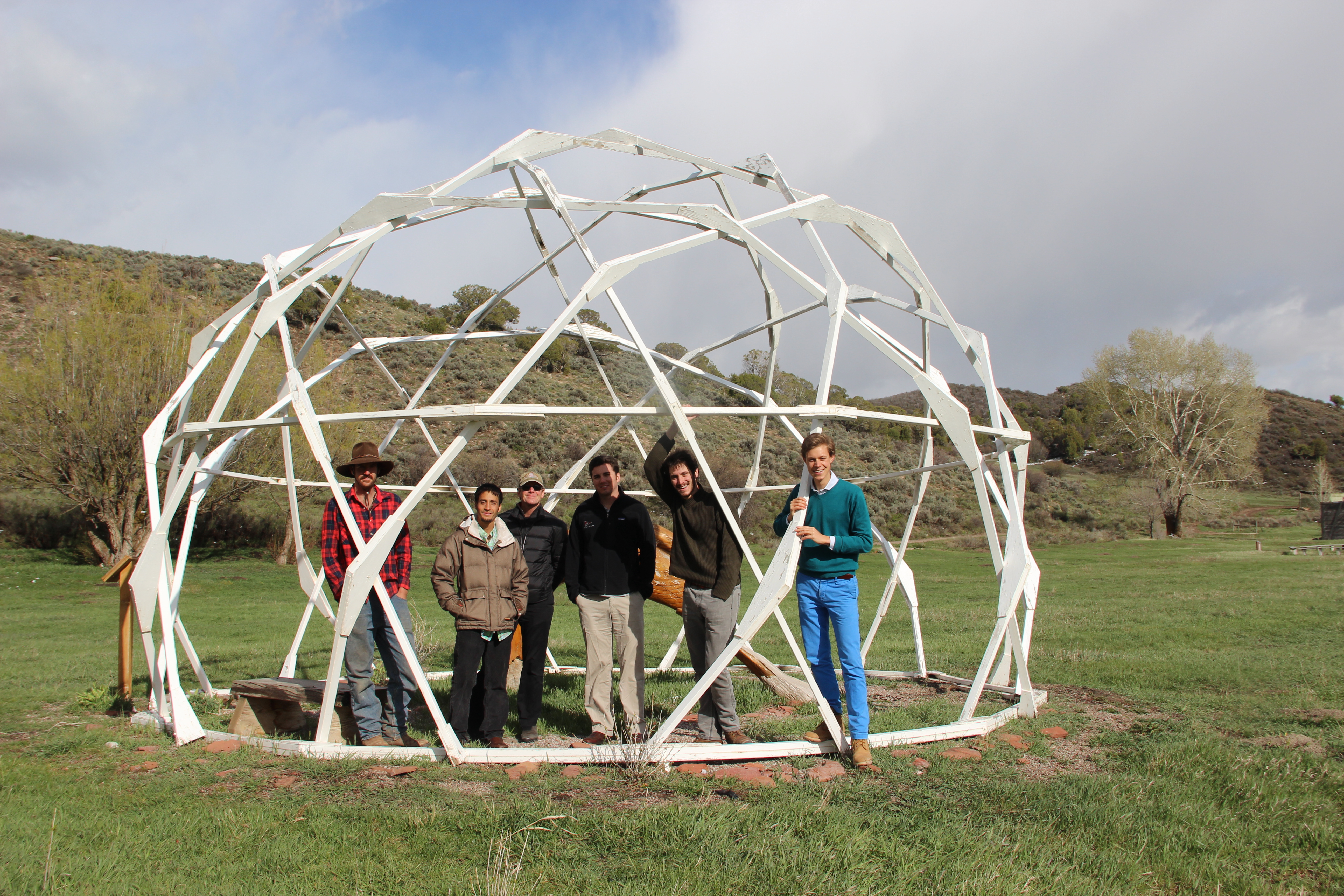
Paul, Eden, Michael, Robbie, Dan, and Titiaan inside the Windstar dome

In 1982, Buckminster Fuller led a workshop exploring geodesics and other topics. From that workshop, the idea arose to build a biodome on John Denver’s Windstar estate in Old Snowmass, Colorado. In the summer of 1983, weeks before construction was scheduled to start, Bucky died of a heart-attack. In his spirit, a group of young architects and engineers including Bill Browning and John Katzenberger built the Windstar biodome.

Biodome Windstar

The original 1983-built 5m-diameter biodome

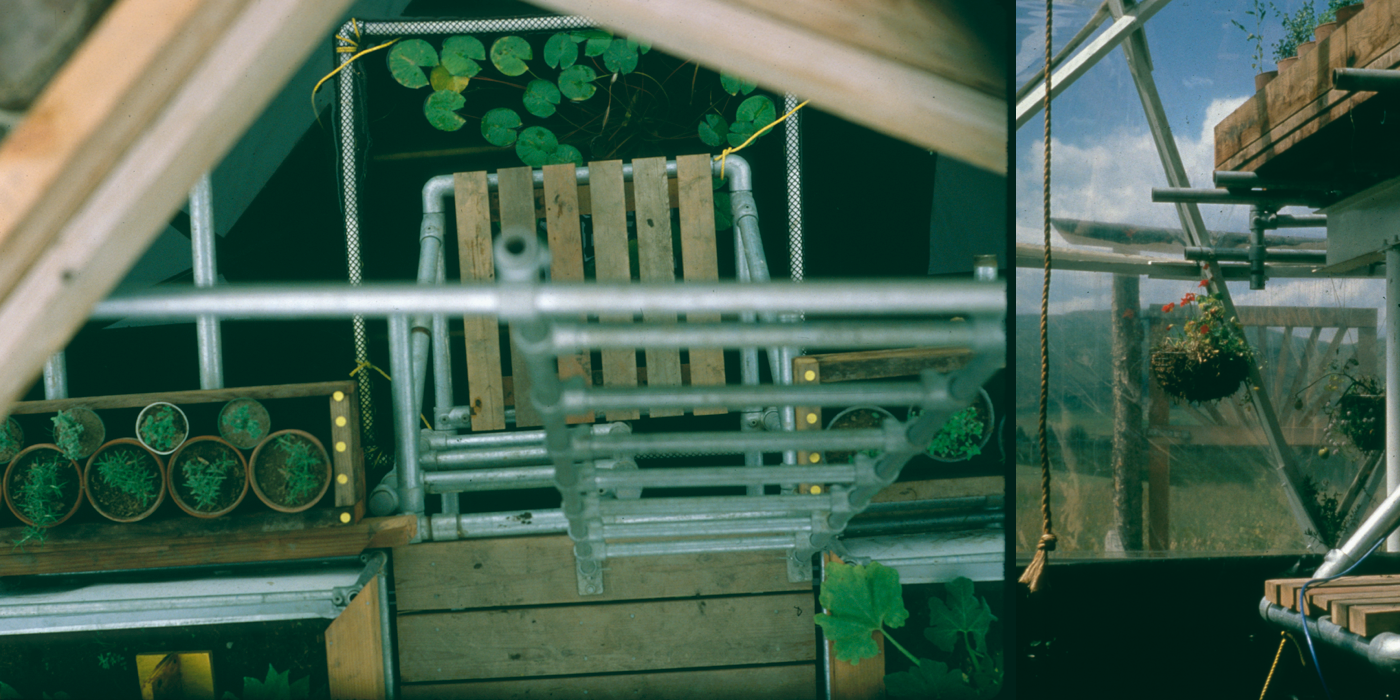
The goal of the biodome project was to produce food locally year-round in a cold climate with solar energy. The dome was glazed with two layers of plastic film separated by an air space. Until the late eighties, the biodome was used to grow a variety of vegetables and fruit. The dome was separated into two levels, the lower level including a pond in which fish were raised, which doubled as a heat storage medium. An army of volunteers was involved to maintain the indoor (and outdoor) gardens. Today, only a structure and many stories are left.
PlantsDome.001

Inside of the biodome: showing multiple floors and hanging gardens

When I arrived at Windstar three months ago and saw the dome, I knew immediately that I wanted to restore this legendary structure. Imagine re-building the last dome Buckminster Fuller designed! I soon learnt that I was not the only person excited about this prospect. Eden Vardy, founder of Aspen Tree, an NGO that aims to connect people to nature through agricultural training, had a similar idea. In fact, Eden and Aspen Tree’s co-director Paul, had erected another biodome close to Aspen in the fall of 2013. After Amory introduced us, it was evident we had to team up.

How to make this idea work? The first step was to develop design alternatives. Eden and I convened eight people—Greg Rucks, Dan Wetzel, Robert McIntosh, Garrett Fitzgerald and myself (all from Rocky Mountain Institute), Eden Vardy and Paul Huttenhower (both from Aspen Tree), and Michael Thompson, an architect with experience in designing grow houses—to participate a design charrette, a process to develop design alternatives.

The first goal of the charrette was to brainstorm design alternatives to glaze or skin the dome. We started the process outside, gathering all participants under the 5m-diameter dome (picture at top of this post), to be inspired by the dome’s history and understand the technical details of the current structure. After sharing stories about the biodome’s original state, we moved inside to start the charrette.

In the next hour, we generated many interesting ideas—building an opaque dome to use for mushroom-growth; using old parachutes as inside insulation; and building a fly-eye dome—and consequently selected four ideas to further develop. The group split into four pairs, each pair given the task to develop a list of materials and next steps per design alternative.
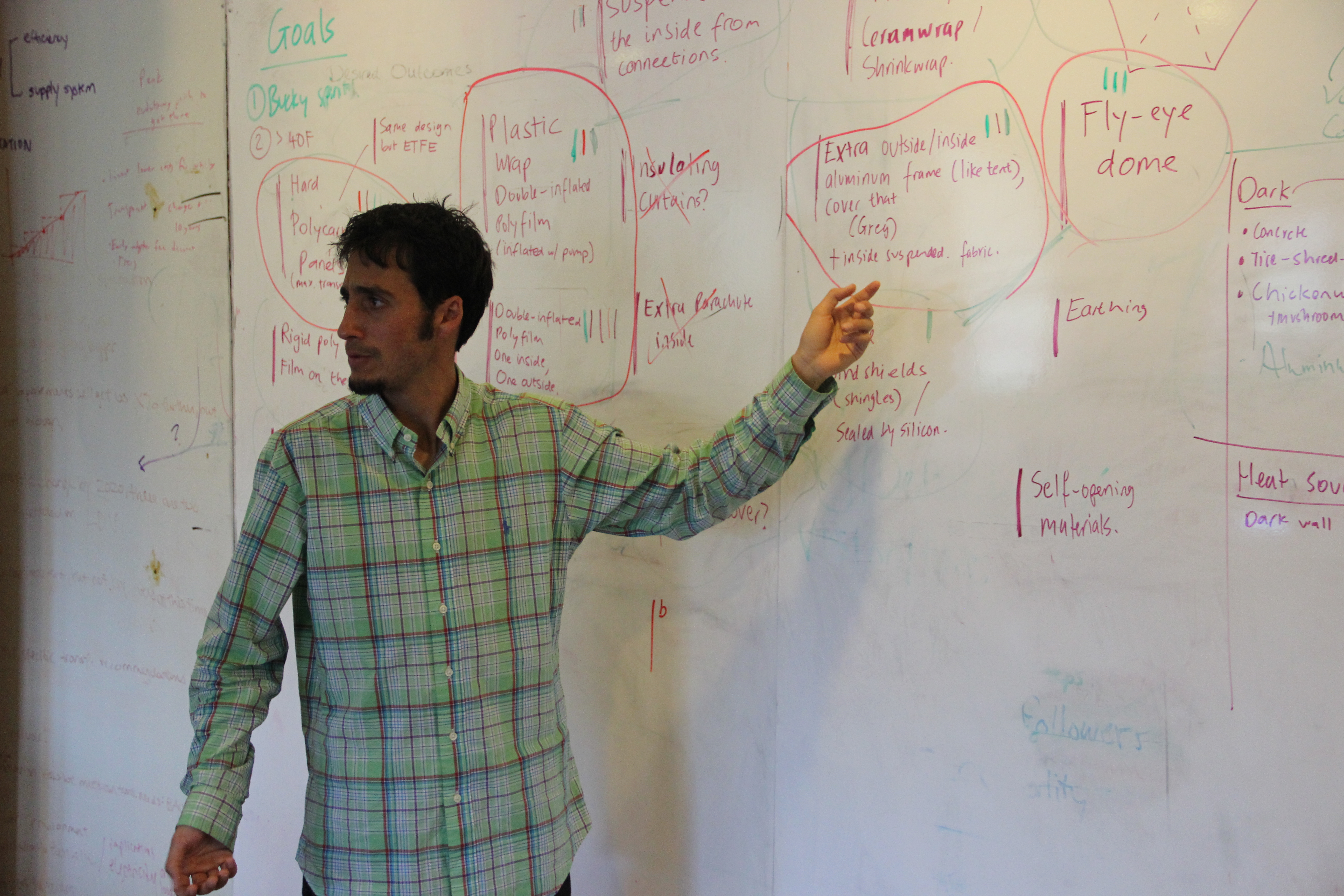
Overview of generated ideas

Eden guiding the selection of four ideas from the charrette to further develop

Four design alternatives were further developed:

1. Hard polycarbonate dome. The current structure is a “basket weave”-dome. As in a woven basket, the ribs alternatively pass concentric or eccentric of one another.  This means there is no flat plane to which to adjust all three sides of a triangle or five sides of a pentagon. Paul suggested a way to fix this by adding plywood to the joints, but the group questioned whether that was in line with Buckminster Fuller’s idea of ephemerilization—doing ever more with fewer pounds of material. Michael estimated that the material costs for the polycarbonate were ~$4,200 for a ~1200 square feet surface area (at $3.50/square foot), or double that if the parts were to be ordered pre-cut.

2. Double-inflated polyfilm dome. This was the design of the original dome (second picture in this post). In 1983, the intention was to perfectly seal the space between the plastic films and fill the space with a gas with a low heat transfer coefficient. The inserted gas between the films quickly leaked out, so an airpump was installed to inflate the “pillows”.  The benefit of this idea would be that few to no more material needs to be added to the structure of the dome. Michael estimated that the material cost for the double-inflated polyfilm would be $1,000 for the dome (at $0.75/square foot).

3. Extra external or internal structure. Greg and Robbie worked on the idea of adding an additional light structure around the outside of the dome, inspired by aluminum tent-poles, over which a permanent or temporary insulating material could be draped. The idea arose of a slinky-type external cover, made of aluminum or carbon fibre ribs and an insulating fabric, that can be pulled across the dome during the night. Michael suggested that an internal additional structure could be a better idea, given high snow loads in Aspen.

4. Fly-eye dome. Dan and Paul explored the idea of creating a fly-eye dome. This type of design would need much material compared to the three designs discussed above. Garrett accordingly asked what the primary goal of the fly-eye dome would be, to which the group agreed that the function was mostly aesthetical.

Whiteboard voting

Michael, Greg, and Robbie voting for ideas.

Reflecting on the charrette, it is most likely we will implement the double-inflated polyfilm dome, possibly with an additional internal structure as developed by Robbie and Greg. The benefits of this design are low material costs, identical appearance as the original, and quick installation.

The next critical steps for the projects are to raise funding for construction materials and to apply for a building permit. If you are interested to help during construction of the dome, please comment on this post.

Dome pattern

Structure of the dome. Note the “basket weave” of the ribs—each rib alternates between passing concentrically or eccentrically by other ribs.

Unknown's avatar

What is your steady state?

I wrote this article in March 2013 after visiting friends in San Francisco. Over lunch in Bangalore, I had a discussion with friends about the things they do in moments of free time. I remembered my idea of “steady state activities”, and wanted to share my reflections at the time. 

Imagine that next week miraculously has 8 days in stead of 7. How will you spend your extra day?

In our free time we tend to default to a limited set of activities. When a day of work is cancelled we pick up a book, invite friends for dinner, or jam on our guitar. I call the set of activities we resort to in times of tranquility – our side projects, our hobbies – our steady state. 

Why is it important to know our steady-state? Because our precious “free” moments are perfect opportunities to do things we love. If you are not conscious of your free time, it is easy to default to “urgent”, unimportant activities: answering email, glancing at newspaper headlines.

“We are here on Earth to fart around. Don’t let anybody tell you any different.”

– Kurt Vonnegut

Your steady state can bring you new perspectives. My friend and great designer Carson regularly visits museums, to study how human organizations have evolved in recent millennia. Maricarmen, entrepreneur and yoga teacher, finds herself dancing to powerful music in her mornings, to energize her body for studying and writing. Eric runs out of the building whenever he has moments to spare on his Kauffman trip, to capture the world from a different perspective through his camera, improving his skill as a photographer.

These are beautiful and constructive steady state activities. They bring joy and inspiration to my friends. They allow them to be more productive in their work. And, over time, these steady-state activities work like compound interest: by spending a bit of time every week, these side projects may one day form the basis of their next big thing.

###

What do you do on a free afternoon? Can you share an example of a skill you built up incrementally on the side over the years? 

Unknown's avatar

Rapid Prototyping by Orangutans … and other reflections on three days in Kalimantan

Matt, Casper, Caroline and Titiaan

Casper invited me to spend a week with our good friend Caroline and his sister Laura at a primate-research project in Borneo, Indonesia. Casper’s friend Matt, the communications director of the Orangutan Tropical peatland project and avid wildlife photographer, had offered to host us. On December 31st 2013, I booked my flight from Bangalore to Kalimantan – starting the new year with an adventure inspired by this article.

It was a great decision. Orangutans are beautiful animals. At rest in the crown of the forest, they look similar to a man sitting in a tree, honoring the origin of their name: “person of the forest”. In their natural habitat they are solitary – orangutans live alone. They feed primarily on fruits and some leaves growing in the rainforest canopy. Males grow flanges (the big cheeks you recognize from pictures) when they start to get ready to reproduce. Few females in the animal kingdom are as dedicated to being a good mother: young Orangutans stay with their mother for 7 to 9 years before they gather their own food.

The Borneo Orangutan Survival foundation operates a rehabilitation centre where orphaned Orangutans are fed and nursed to go back into the wild. To get re-acquainted to living in natural forest, Orangutans spend months to years at the half-way stop, an island in a river where they can room around freely but still receive food. Every morning a boat drops bags full of vegetables and fruits at several feeding locations on the island’s banks. We were lucky to see this spectacle from a boat moored at a few meters distance.

Orangutan_Titiaan

Alfred making his canvas’ hammock

After one bag of ears of corn had been emptied, one of the Orangutans – let’s call him Alfred – showed us his inventiveness. Alfred ripped open the bag along one side and put it over his head a cape. Fed up with the cape, he put the canvas material under his armpit and climbed up a tree to show us some rapid prototyping skills. Alfred hang one side of the cape onto a branch and tried to crawl into the canvas bag to use it as a hammock.

Once he succeeded, preparing to take a nap, one of his friends came to claim his hierarchy by stealing the bag. Alfred was scared out of the tree, but his fellow Orangutan did not have the perseverance or curiosity to make a hammock out of the bag – it looked so much easier when his friend had done it – and threw the bag down into the river (as for humans, easy access to an object often seems to reduce the pleasure experienced of that object). Alfred climbed down immediately to fish the bag from the river, trying to make a hammock once again. A creative, persistent fellow.

Before visiting the BOS foundation, we spent two days in the natural forest with OUTrop. As Matt and I made our way through the forest on one of the morning walks (walking through knee-deep peat-swamp), we had a direct encounter with a young male Orangutan. Fully focused on eating fruits 10 meters up in a tree, the Orangutan did not notice Matt and me at first. As I cracked a branch, the Orangutan suddenly saw us. He looked us straight into the eyes, grabbed a branch above his head and snapped it from the tree. He held it threatingly above his head, and then threw it to the ground with his strong arms. Then, he aggressively swung his body to another tree and Matt and I left the site. It made a deep impression on me.

Orangutan_foret

Leaving Kalimantan tomorrow to meet with Willie Smits, the Orangutans have left a deep impression on me. They are peaceful animals, able to determine their own plan, not disturbed by the process of group decisions. I came to see the Orangutan as the “philosopher king” of the animal kingdom, not disturbed by trivial matters, peacefully exerting only the necessary effort, solitary contemplating the meaning of life (whilst chewing leaves) from a treetop.

When did you feel a deep connection to other animals?

Unknown's avatar

Bustling Bangalore

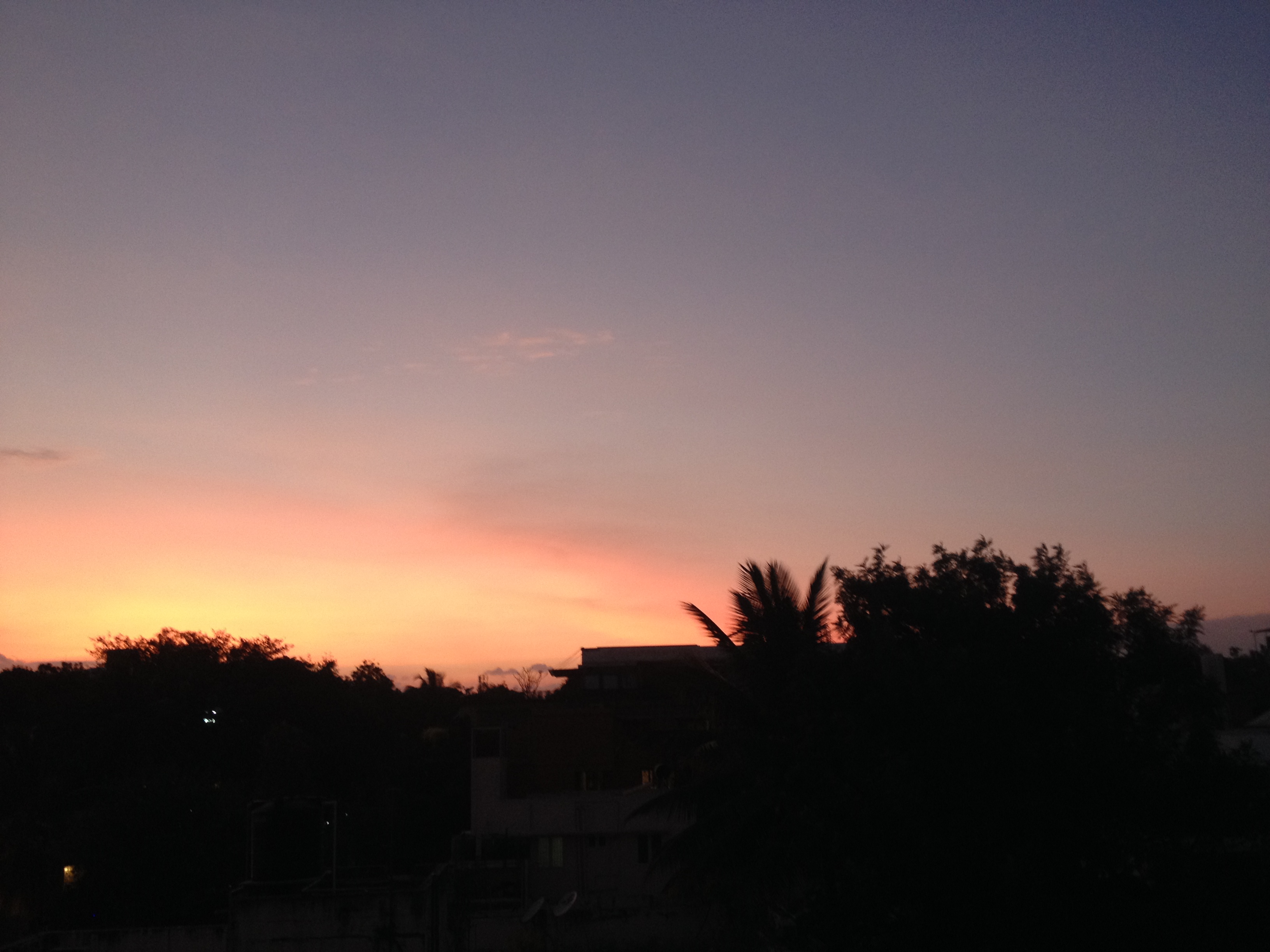
Sunset in Bangalore

Last week I arrived in Bangalore. After a thrilling week in India, I am glad I had the courage to book a last-minute flight to Bangalore once I was told that I had to wait for two more months for my U.S. working visa.

Adjusting to life in Bangalore is easy. Many speak English and tasty food is available on every street corner. Several great groups of people invited me to work with them, bringing meaning to my days in India from the moment I arrived. I stay with wonderful friends who double as great hosts. I go to sleep every night having learnt at least three new things.

Buildings, infrastructure and transportation

Buildings shoot from the ground everywhere, although access to a proper home is unevenly distributed. The picture below shows a tent community in front of a newly erected building.

Building and slum

Bangalore’s streets are surprisingly clean, but waste’s final destination may be nearer than you think. I was surprised to discover this garden with integrated garbage dump one morning as I woke up to watch the sun rise from my roof terrace in Indira Nagar.

IMG_5967 

Transport in Bangalore is hectic. The first days I traveled by riksha (called “autos”, I actually drove one an auto last Sunday evening), but I quickly decided to test the public bus system. Boarding the bus on my first ride, I was surprised to see only women sitting! When I turned my head to look towards the rear of the bus, I realized that all men were sitting in the back. This is an unspoken rule I’ve observed on buses since, so that women have a place to sit. I wonder how it was first implemented.

Women in bus

Providing access to electricity to the poor

On Wednesday and Sunday I went out into Bangalore’s tent-communities (slums) with the wonderful fellows and interns of Pollinate Energy. Pollinate provides access to electricity to people who do not have access to the grid. They do this by recruiting entrepreneurial twenty-year-olds from local urban communities – called Pollinators – to sell products that people want: solar panels, lights integrated with mobile-phone chargers, cookstoves and possibly soon modular homes; tablets and low-voltage TVs.

I quickly learned that it is essential to work with local entrepreneurs if you are to sell products. When I enter a community – a European with blonde hair and white skin who speaks not a word of Kannada – it stirs up many reactions, yet these do not necessarily lead to an interest in the service we are trying to provide. The real value is created by someone the community can trust – a boy like Madu in the picture below, who gently explains the benefits of not using kerosene. What is important is that the community can trust the storyteller.

I also learned that people’s dis-interest in an electricity-providing product can have many more reasons than poor product design. In two days, I have heard people explain that they fear that the solar panel will be stolen; that neighbors will destroy the solar lantern; or that they simply do not want to be the first of their friends to buy the product.

Madu in tent camp

A little running

After Wednesday’s visit to the slum, Monique and Jamie from Pollinate invited me to participate in Bangalore’s midnight marathon run – the 10km version, not the original Greek length – on Saturday night. Dressed up as light-emitting bees (yellow shirts, black tights, LED-light strapped to our chest) more than twenty of completed the track in Whitefields – cheering and screaming to one another as we passed.

Bengaluru midnight marathon

I spent the last two days with Infosys’ Green Initiatives team. Under the leadership of Rohan Parikh, this group of 15 very competent engineers are committed to realizing the world’s most energy-efficient buildings. Since 2008 the team has reduced energy consumption in new buildings by almost 50%. My goal is to work with part of the team to realize a bold project in the next five weeks.

Sunset from the roof

Unknown's avatar

7 Paths For Guaranteed Misery in Life

You can not tell people how to be happy, but you can tell them how they will become miserable. If we avoid paths to misery, we increase our chances of a happy life. “I wish I knew where I was going to die, and then I’d never go there.”

Below are 7 paths for guaranteed misery in life, from Charles Munger’s 1986 Harvard Commencement speech, from the book “Seeking Wisdom” by Peter Bevelin. What surefire paths to misery would you add?

 #1 Ingest chemicals in an effort to alter mood or perception

 #2 Envy

 #3 Resentment

 #4 Be unreliable

 #5 Learn only from your personal experience

Avoiding to learn from the mistakes of others will surely bring you to misery.

How little originality is there in the common disasters of mankind – drunk driving deaths, […] conversion of bright college students into brainwashed zombies as members of destructive cults. […] “If at first you don’t succeed, well, so much for hang gliding.”

 #6 Stay down when life knocks you to the floor

There is so much adversity out there, even for the lucky and wise, that [staying down when life gets tough] will be permanently mired in misery.

 #7 Do not think backward

Approach the study of happiness by studying how not to be happy, in other words:

Approach “How to be X?”

By asking “How not to be X?”

This video is part of Charlie Munger’s commencement speech at USC. Find the transcript of the speech here. 

Unknown's avatar

The art of flying

Clouds from the planeI love to fly. On flights I find time for long stretches of reading. Floating high above the earth’s surface brings a mental distance that is great for reflection.

But the experience of flying can be more tranquil and pleasant if airlines make these small changes:

  • Board passengers in small groups, with group numbers printed in large font on your boarding pass. If it is clear when you are allowed to board the plane, there is no need to push yourself forward in a long line at the gate.
  • Do not interrupt movies for (duty free) announcement messages. Also, why is it not possible for passengers to start movies when the plane is still at the gate or taxiing?
  • Do not turn on all cabin lights on an overnight flight 1 hour before landing. The flight from Boston to Amsterdam takes five-and-a-half hours, leaving 3 hours of sleep between dinner and arrival. Why would you wake everyone up for the final hour-and-a-half? Is it not possible for passengers to switch on their individual reading lights if they want breakfast?

You can try to find tranquility even when your environment disturbs you:

  • Plan to be at the airport early. I have created an annoying habit of delaying my departure to the airport to the latest moment. This led to my first missed flight recently. Plan to be early: you will make up for the “lost time” of leaving early by a gain in mental clarity during your travel to the airport.
  • Do something at the airport that makes you peaceful. Annoyance builds up when you focus your mind on the chaos around you. Listen to classical music, a podcast or an audiobook. I sometimes read even while standing in line to board, although this makes me look like a failed acrobat – trying to move my bags with my feet while keeping my eyes on my reading.
  • Bring an eyemask and ear buds in your carry-on luggage. When you enter the plane, you can take a nap straight away.
  • Talk to strangers. Have a chat with the person sitting next to you at the gate or on the flight. Small talk and jokes bring happiness. Plus: the person sitting next to you may tell you an amazing story (or even become the love of your life).

What are your travel tips? What do you do when you’re waiting at the gate or on the plane? Do you bring special things with you?

Unknown's avatar

Nature’s independence

I wrote this blog mid-June, one week after leaving San Francisco. 

Image

Riding through the foothills of the Sierra Nevada we were surrounded by pristine pine forest. The environment reminded me of journeys to Sweden, Istanbul’s Star Islands and the Croatian coast.

As I stood in the middle of a quiet road in the forest, two deer walked onto the road. Meters away from me, both deer stopped and stood still for what felt like a full minute. As I set a step in their direction, the deer gently moved off the road and graciously hopped into the forest. It was a magical experience.

Our road has been marked by beautiful scenery. Unfortunately, we are not allowed to enter much of it: the vast majority of forest along the road is marked by “No Trespassing” signs indicating that “visitors are not welcome”.

Image

The craving for possession of land is foreign to me. In Sweden, any person can cross another man’s land as long as the visitor treats the land with respect. This “freedom to roam” is a constitutional right. After all, we are all visitors on earth – the land belongs to no one.

Bliss or pleasure is derived not from possession but from service: walks through the woods and squirrels playing in your backyard versus a document that states your ownership. As Emerson writes:

“Miller owns this field, Locke that, and Manning the woodland beyond. But non of them owns the landscape. There is a property in the horizon which  no man has but he whose eye can integrate all the parts, that is, the poet. This is the best part of these men’s farms, yet to this their warranty-deeds give no title.”

Unknown's avatar

The universe conspires in your favour

Image

Forty miles south of Kansas city, on a sunny afternoon, half our Spokes team stops to refill our flasks with cold water at a small roadside restaurant. After she walks in, Claire explains to the man behind the counter that we are crossing the country to help teenagers start hands-on projects, because we believe that every child deserves to feel empowered to realize their ideas. Within minutes, free nacho’s and hamburgers are on the table (this is America…) and we are offered a place to stay for coming nights.

At such moments, I feel like a monk receiving a three-star Michelin-dinner after asking for alms.

Surprisingly, such generous offers have occurred regularly during our journey. No week passes by without a stranger reaching out to help us. How can this be explained? Is this mere coincidence?

I believe the support flows from a deep commitment to the cause we are fighting for. We put our heart into this project. People see us, recognize our commitment and a desire arises with them to contribute – to be part of our story. This speaks to the natural desire of people to do good. Better yet, I experience now the incredible power that you can unleash when you fight for something you care about. 

I am not the first to observe this. Emerson writes in the first pages of his essay on self-reliance:

“Every heart vibrates to that iron string”

Paulo Coelho puts this into words in the Alchemist:

“When you want something, all the universe conspires in helping you to achieve it.”

And Seth Godin has created an entire body of work around helping people to overcome fear and do what they care about. As said in the Icarus Deception -“Fly closer to the sun.”

I commit to putting my soul into my work.

Unknown's avatar

A quest for learning – summer 2013

This summer, I embark on an epic quest. With 8 students from MIT and UC Berkeley, I’m cycling 4,000 miles from San Francisco to Washington. Along our journey, we will teach hands-on science classes to a total of 1,000 high-school students on topics we deeply care about, organized as “Learning Festivals”.

Classes range from “How to build a heliostat solar panel?” to “How does the brain work?”. Each Learning Festival will end with a session in which we invite students to work on their own ideas. The goal of our journey is to let children experience the joy of learning and the power of turning ideas into reality.

Updates

For email updates of the highlights of our journey (2x per month), please leave your information here. I keep another blog during the summer, please find it here. 

A demo class in Amsterdam

A demo class in Amsterdam

How can you help? 

Thank you for taking the effort of reading this page! There are several ways in which you can help:

(1) We are looking for teaching locations across the country (see the map below). Are you in touch with school teachers, librarians or summer camp leaders along our route? Please introduce us, spokes [at] mit [dot] edu!

(2) We will be camping all the way. Do you have friends who live along the path, who are happy to host 8 students for a meal or a night? Please introduce us, spokes [at] mit [dot] edu!

(3) This journey will lead into a structural organization to support children in developing their own ideas beyond summer. Do you want to work on or fund the future of hands-on learning? Definitely reach out, spokes [at] mit [dot] edu!

Team

Along our journey, we are supported by a large team of web designers, educators and funders. During our trip, we will be 8: 6 MIT students, 1 UC Berkeley student and myself .

Our team of 8

Our team of 8

Curriculum

1. COMPUTERS, ART:  The algorithmic beauty of plants

Do you like computers, plants, or art? How about the intersection of all three? In this course, we explore the recursive structure of plants and learn how to make pretty pictures of trees, flowers, and abstract fractal-like patterns using a clever technique called L-systems. Everyone will have a chance to create their own computer-generated works of art inspired by life.

2. NEUROSCIENCE, GAMES:  EyeWire: a game to map the brain

EyeWire is a puzzle-meets-coloring book online game that enables its players to contribute to the brain mapping initiative, which was announced by President Obama in March. Developed in part by one of the Spokes teachers in the Seung Lab at MIT, the game teaches its players how to trace the “branches” of neurons through 3D reconstructions of brain tissue. To do this task, players “spot check” computer algorithms, with the ultimate goal of obtaining a connectivity map with synaptic-scale resolution of the “connectome.”

3. ENERGY, CONTROL SYSTEMS:  Build your own solar panel heliostat

Through assembling their own solar panel heliostat, students will gain insight into the fundamental working or energy from renewables. This class combines knowledge in mechanical engineering (designing a technical system), computer science (programming an arduino) and electrical engineering (soldering the board).

4. FOOD, GARDENING:  How to grow your own vegetables: inside, for free!

Don’t you wish you know how to make your own delicious food? With a few old plastic gutters, a handful of plant seeds and a bit of daily care, you will grow your own veggies in no-time! Add in a few quick and easy recipes, and you will be the most popular chef in your high school – period.

5. MUSIC, PHYSICS:  The Science of Music

Music has been called the universal language. In some sense its building blocks of rhythm, harmony, and melody arise from the nature of the human mind. But there are still a lot of unanswered questions! Come learn about the math, physics, and psychology behind the music we love and how to take a scientific approach to solving its mysteries.

Journey

Our route from San Francisco to DC

Our route from San Francisco to DC

Partners

Spokes_Partners_1

My class

The class I will teach is called: “Grow your own vegetables – the joy of making what you’re eating”. I have created an entire outline of my class (using pictures, very few words) here.

See you in DC!

See you in DC!

Unknown's avatar

A model for rapid (uncomfortable) learning

Picture yourself sitting at a conference. One of the speakers asks the people in the audience to raise their hand if they prefer electricity from solar over electricity from coal, oil or natural gas. Chances are, you would raise your hand – of course, “greening” our energy system is important. The question is: does this rational decision lead to a change in your behavior?

Last weekend, I participated in Lean Startup Machine Rotterdam. The goal of the weekend was for participants to rapidly test possible business ideas, by relentlessly interviewing potential (i.e. hypothetical) customers. Many gifted programmers or engineers have spent months, if not years, to build beautiful, detailed websites or airplanes, only to find out that nobody wanted to buy their “solution” once it was completed. To reduce time wasted on undesired products, the “Lean Startup” methodology was created by Eric Ries, as a process to test what people want to pay for, before you start building. Following the “Lean Startup” methodology, my goal for the weekend was to identify groups of people who were willing to invest in renewable energy. I was joined in my quest by Jaap Ruoff, Raffi Balder and Daniël Muller.

Looking at your monthly expenses, how do your purchases reflect the things you say you care about? The first thing I learned this weekend was that although many people say renewable energy is important, few care enough about the topic to allocate money to it. We asked 8 parents whether they cared about the societal impact of the money they were saving for their children. Unanimously, the parents shared horror stories about their investments the past years, and that the only thing they cared about was to have a secure, very-low-risk place to store their money.

Retrieving our confidence, we went out again into a wealthy neighbourhood to ask people whether they felt engaged to invest in solar panels on a school. Only 3 out of 19 people answered positively – all three had interpreted the question as if it were the school of their children, unlike many of the other respondents.

This response provided us with a hint: the desire to contribute to sustainable energy projects may be related to a direct social connection to the location. Based on the fact that only 22% to 27% of US citizens have a roof suitable for solar, we decided to develop a solution for a new (hypothetical) customer and pain: one of the lucky quarter of Dutchies that have a solar panel-fit roof, but can’t finance a solar panel system alone. We tested our customer and problem hypothesis in two ways: we built a landing page for an early adopter (someone with his own roof and 3,000 twitter followers) and we started calling friends around a proposal to invest in a local school.

Sure enough, data started pouring in. The landing page we built attracted 255 unique visitors. None of the visitors left their information to buy a “solar share” – our name for the €50 investments visitors could make in the early adopter’s rooftop solar system. From our calls, we learned that our friends were willing to invest a small amount of money (e.g €50) in a private solar panel system, but a larger amount of money (e.g. €200) if the solar panels were installed on a school.

Most importantly, I was reminded how great it is to work with smart people on a challenging project, utilizing an unfamiliar process whilst operating far out of your comfort zone! Approaching people on the street, asking them about their needs will always instill fear initially, but it is such a rewarding experience! Thinking back of similar environments (specifically 3DayStartup in Amsterdam & Social Good Hackathon in Cambridge), these are the kind of environments that foster very rapid learning.

I noted earlier the learning that a societal need is not always equal to an individual pain or desire. If educational institutions can transform their high-level need for innovation to a burning desire, the Learn Startup Machine model can be a medicine to their pain.