Unknown's avatar

The most important questions in the world?

The point is to live everything. Live the questions now. Perhaps then, someday far in the future, you will gradually, without even noticing it, live your way into the answer

—Rainer Maria Rilke

Last weekend, I had breakfast with my dad. I explained that I feel particularly satisfied on days when I create something—a blog, a drawing, or a beautiful graph—and share it with someone. My dad smiled. Then, he replied, “I have a good day when something unexpected happens.”

As he said this, I realized that how you evaluate your days determines the person you become.

There are many questions we can ask ourselves daily, such as:

  • Did I create something meaningful?
  • Did I learn something new?
  • Did I make someone smile?
  • Did I get better at my craft?
  • Did I meet someone new?
  • Have I become a wiser person?
  • Did I encounter something unexpected?
  • Did I help somebody?
  • Did I do something that scared me?
  • Did I work on something that can change the world?
  • Did I invest in the people around me?
  • Did I work with amazing people?

It’s worth asking yourself: am I asking the right questions? There is no one-question-fits-all, but each question reflects certain values. Asking, “have I helped someone?” means you value compassion and kindness. Summing up what you’ve learnt at the end of the day indicates a commitment to personal growth.

Which questions do you ask yourself at the end of your day? Do they reflect what you truly care about, or are they merely a product of your environment and the past?

Thanks to Jan Overgoor for reviewing an earlier version of this post.

Unknown's avatar

3 cool tools to learn how computers work

1. Kano: a $150 kit to build your own computer. Kano ships you a beautiful package with a Raspberry Pi, a case, a small speaker, a keyboard with trackpad, and a WiFi module. Using Pi’s linux operating system, you can download existing games, or build your own.

2. littleBits – a library of magnetic electronic blocks that allow you to create and invent. littleBits is an ever-growing library of electronic modules that snap together with magnets so you can invent anything without the need to solder or connect wires. LittleBits’ library has 60 modules, including temperature sensors, microphones, buttons, motors and many more.

3. arduino is an open-source electronics platform that provides the raw material for anyone making interactive projects. At MIT, several of my friends used arduinos to prototype their solution. After teaching at MIT’s medialab India Design Initiative, I was so interested that I bought an arduino as part of a SparkFun kit. I used the kit to build several designs, and then I created my own thermostat. It wasn’t connected to my heating system, but the output (a light) would switch on if the boiler had to switch on.

The thermostat I built with my arduino-kit. When the temperature would be below the setpoint (21 C), the output (an LED, in this example), would switch on.

The thermostat I built with my arduino-kit. When the temperature would be below the setpoint (21 C), the output (an LED, in this example), would switch on.

###

Do you want to understand the basics of computers? Get Danny Hillis’ terrific book “The Pattern on the Stone”. The book details through clear examples how computers work, without going into unnecessary details and all the time nurturing curiosity.

Unknown's avatar

Lessons and Impressions from Beijing

I spent last week in Beijing, my second visit to the city after a short visit with my father and brother in 2009. I was in Beijing to work on “Reinventing Fire: China”, a collaboration between Lawrence Berkeley National Labs, China’s Energy Research Institute, and Rocky Mountain Institute to model a deeply efficient energy future for China up to 2050.

I enjoyed Beijing tremendously, and I was struck by how different an impression the city made just a few years after my first visit. Below are some of my impressions.

Public infrastructure

We mostly used the subway to get around the city. For 2 RMB (less than $0.30) you can ride the subway wherever you want. Trains arrive every three minutes, are spick and span, and there’s enough space not too feel like a sardine. Riding Beijing’s metro was a far better experience than taking the BART in San Francisco, and it rivaled the best European subways I’ve been in.

(The subway is also much quicker than taking a taxi: Beijing suffers from heavy congestion, despite (or because of?) the five-lane roads throughout the city.)

Cleanliness

Anyone who walked around Beijing in the last few years will know that the air is typically full of smog. People check air quality on their phone, just to see how many times the limit of the World Health Organization is hit. Fortunately for me, the air in Beijing was exceptionally clear this week: we had blue skies every day.

The streets were also very clean. Returning to my hotel after dinner one night, I walked through a series of Hutongs, traditional Chinese urban settlements, and noticed that there was no trash or dirt anywhere. Several Hutongs also had public toilets, a piece of infrastructure you don’t see even in financially rich Western cities.

IMG_3374

Diet and health

Most days I would get breakfast, typically an egg sandwich, from small carts on the street. For lunch and dinner we would frequently have big, warm meals. (To deal with the after dinner dip our Chinese collaborators would take a little nap face-down on their desks.)

IMG_3367

Despite the big meals, most Beijing inhabitants were quite fit. I did not see any of the gigantic bellies you spot in the United States. (Hopefully this will not change as American fast food and soda spreads in China.)

IMG_3387

Outdoor exercise equipment was installed in multiple public spaces. Chungliang Huang, the Tai Ji master who taught at Esalen this weekend, said it was normal for Chinese people (at least traditionally) to start the day with movement. I forgot to ask my Chinese colleagues if they typically work out before coming to the office. (One day after lunch, our Chinese colleagues were in full battle gear, playing ping pong in the hallway.)

IMG_3428

Architecture

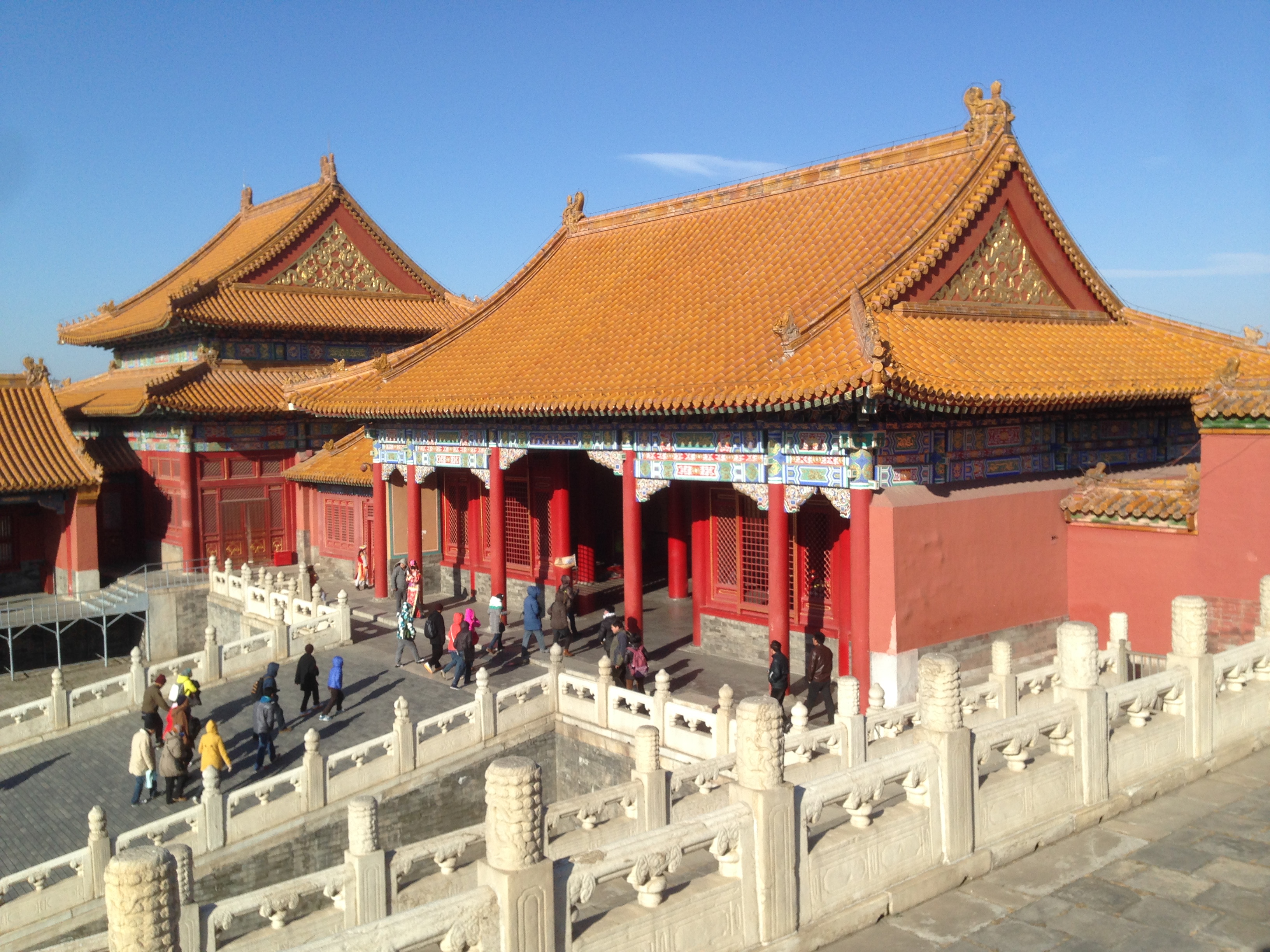
The palaces of the Forbidden City and the buildings around the Temple of Heaven had a beautiful color scheme: dark red, gold, deep green and ocean blue. I love the simplicity of many of the temples, and the order of the floorplans when you look at the old palaces (and Hutongs!) from above.

IMG_3412

Collaboration

One goal of our work in China is to define what the maximum potential for energy savings for different industries is (e.g. for production of cement). It has now happened multiple times that agreed upon analyses are changed the night before a big presentation by “expert adjustment”. The reason for this seems to be that our research colleagues want to tell a message that their bosses will agree with. This hierarchy creates challenges for scientific rigor (and innovation).

Our team now has several Chinese nationals on board, who can communicate directly with our Chinese colleagues and clients (most of whom do speak English). That said, having an interpreter often take the flow out of the conversation. I look forward to the day when spoken word can be instantly translated, so that both parties can engage in interactive conversation.

Chuangliang Huang, Amory’s co-teacher at Esalen Institute in Big Sur, explained that a single Chinese character can hold many different meanings, depending on its context (the characters that surround it.) Amory speculated that this leads native Chinese speakers to be more comfortable to hold in their mind ideas that seem paradoxical to Western minds, a helpful quality for anyone who wants to study quantum physics.

Conclusion

Overall, I was really impressed by how quickly Beijing is developing. I realize that living in one city for a few days do not represent life in a country of 1.4 billion people. That said, working in Beijing during a period of clean skies felt more like living in London than like living in Bangalore. Culturally, Beijing feels different from Bangalore too: if life in India is chaotic, colorful, and emotional, Beijing is much more organized, clean, and productive.

###

If you’ve been to Beijing, what was your experience? For some of my Chinese friends, how do they think about this? Should a Chinese government stimulate urbanization, or incentivize people to stay in rural towns so the deep social disruption between elderly people doesn’t take place?

IMG_3379

Unknown's avatar

4 Dutch projects you should know about

Now in Beijing, I spent the last two weeks in the Netherlands. Here are four Dutch projects that inspired me.

1. Ocean Cleanup
Boyan Slat’s ocean cleanup addresses a truly super-national problem (floating waste in oceans), with no direct commercial benefit to the founders. Supported by a young founder who combines a hacker-ethic with deep skill in involving the public (the team raised $2.1M through crowdfunding) , you see why it’s easy to be a fan. Boyan would fit well between the Thiel fellows.

2. Vandebron
Vandebron is a platform for Dutch citizens to buy renewable power from local farmers with excess electricity production. The idea of decentralized electricity sharing is promoted by many, but Vandebron is the first company I know that has successfully created a platform through which individual citizens can sell and buy power, becoming an “airbnb for electricity” as Matthew and I wrote on RMI’s blog.

3. Smart Highways
During the Singularity Summit in Amsterdam last week, Dutch artist Daan Roosegaarde showed the audience two of his latest pilot projects: a bicycle-path inspired by Van Gogh’s “Starry Nights” and a glow-in-the-dark paint that can illuminate highways without overhead lighting. Roosegaarde’s ability to apply natural inspiration to objects in our physical world like roads, churches, and public parks in an artistic way fascinates me. Watch his excellent Zomergasten video here. Highly recommended!

4. Stroomversnelling
During a visit to Shell with Amory, Maaike Witteveen told me about this project to reduce energy consumption of Dutch residential buildings, called “rijtjeshuizen”, by 80 percent, by adding insulating wall panels, superwindows, solar PV, an air source heat pump. Led by BAM, a Dutch developer, and financed by housing cooperatives, incentives between tenants and the housing cooperative align: tenants reduce rent when using less energy; housing cooperatives reduce costs. Maaike and I will soon post a blog describing the potential of the concept on RMI’s blog. For now, here’s a description from the Guardian.

Unknown's avatar

Mastery: the path to success, one skill at a time?

It’s common wisdom that being good at something is valuable. Is it wise, then, to optimize for learning one skill compared to building some proficiency in multiple skills?

I am naturally interested in many things. During a typical week at work, I write and review articles, structure arguments, do analyses in excel, create graphs, code, and more. Add to that the reading, sports, music, and drawing I pursue in my free time, and you start to see the wide variety of my activity. I sometimes wonder: is it smarter to focus on becoming very good at a single skill, rather than doing a little bit of many things?

In So Good They Can’t Ignore You Cal Newport suggests that focusing on a single skillset is more valuable than pursuing multiple interests.  Cal argues that, follow your passion” is poor advice. He suggests you increase your chances of success by building rare and valuable skills. Cal calls this the ‘craftsman mindset’, a relentless focus relentlessly on what value you’re offering, using deliberate practice to grow. He recommends that you stop asking yourself “am I doing what I love?” and start asking yourself “am I building a valuable skillset?”

After reading Cal’s book, I noticed myself thinking “Should I focus all my effort at mastering a single skill?” I hesitated to answer this question with “yes”. I can’t remember a time where I focused on mastering a single activity and I do not aspire to be a deep domain expert, spending decades working in one discipline.

Shortly after finishing the book, I listened to a podcast by Tim Ferriss, The Top 5 Reasons to be a Jack of All Trades. (Blog version here.) Tim Ferriss acknowledges that being very good at something is valuable, but he says it’s a false, commonly held assumption that you can only be very good at one thing. Tim suggests instead that you can become very good at anything after a few months of focused and smart learning, and because of that you can be very good at many things.

That idea—that mastery is valuable, but does not need to be limited to a single skill—was music to my ears. Upon reflection, I found this is only possible under two conditions: take one skill at a time, and use deliberate practice to improve.

Learn one skill at a time

Learn different skills in series, not in parallel. In a good week, I may create a drawing, play a bit of piano, and code for an hour or two. I focus on learning many things at the same time. As a result, I do not experience the intensity to get really good at any of them. The solution, I am finding, is to adopt one or two skills you want to learn this year, and commit to learning only those. Although this focus is difficult for me (I have not built the habit of doing so), I commit to spending two hours every day on one skill for the next three months, building websites, because I notice it’s a combination of design and engineering that I enjoy.

Practice deliberately

Learning skills in series is insufficient—you need to learn skills effectively too. Taking drawing as an example, I experience no peer pressure to produce a drawing every day, and there is no teacher who evaluates my sketches. Even when you focus on one or two skills at a time, you need deliberate practice (another concept from Cal Newport’s book) to grow. This stretching yourself to perform uncomfortable exercises. This means stretching yourself to uncomfortable exercise (for instance, drawing a portrait if you’ve never done so), and asking for direct feedback on your work.

The question is: can I stick to this framework to learn one to two skills each year. Do you agree? Was there a time where you learned to master many skills at the same time? What is the path you follow?

And, considering our changing world: how valuable is specialization in a world where more work is automated?

###

Thanks to Franziska Becker, Ted Gonder, Giles Holt, Philo van Kemenade, Marin Licina, Tobias Rijken, and Max Song for reviewing this blog.

Unknown's avatar

How Apple’s Watch Could Save Energy

On September 9, Tim Cook unveiled the Apple Watch, “the most personal product” Apple has ever made, says the company, “because it’s the first one designed to be worn.” The watch joins other products like bracelets from Fitbit and Jawbone in a category called “wearable technologies,” or wearables.

Beyond decorating your wrist, these products are primarily worn to send, receive, and process information, through cellular networks, WiFi, Bluetooth, or—unique to Apple’s Watch—near-field communications (NFC). The Apple Watch can monitor your heart rate, track your location (through an accelerometer, gyroscope, and GPS), and recognize your voice.

THE WEARABLE DIFFERENCE

Smartphones and their apps have already been doing great things for users managing their energy (and much more, including fitness), for example through connected thermostats, electric vehicle charging, solar panel output monitoring, sharing-economy services, and much more. So why would you wear Apple’s Watch when you have an iPhone? What extra value do wearables unlock that already isn’t accessible through other technologies?

First, wearable technologies can collect biological data, such as your heart rate and body temperature—that a phone in your pocket cannot. These data sources can tell a more complete story about your physical state than data from your phone. Second, wearable technologies are less likely to be separated from the user. Unlike phones, most users will wear their Apple Watch in the shower or in bed. In other words, it’s always with you.

This connectedness between wearable tech and the wearer opens up at least three categories of energy management opportunities: at home, at the office, and personal.

ENERGY USE IN YOUR HOME

Wearable tech can help better match our homes’ energy use—especially heating and cooling—to our needs. For example, Nest’s Learning Thermostat has a built-in motion sensor. It’ll put your home’s HVAC system into an energy-saving “away” mode after a period of inactivity. But imagine how much energy could be saved if a device on your wrist signals your thermostat to go into “away” mode the moment you leave your home or neighborhood.

Similarly, programmable thermostats can be set to pre-condition your house so that it’s a comfortable temperature when you wake up and roll out of bed in the morning. Some smart thermostats even detect when you typically wake up during the week and create a fixed start-up time for your thermostat based on that. But wearing a device on your wrist—which is either connected to an alarm to wake you up, or which detects your sleep cycles and learns when you’re likely to wake—can more accurately tailor your home’s pre-conditioning to match your actual wake-up time, rather than a weekday thermostat program set to the same time, on average, you’re likely to get up.

ENERGY USE IN YOUR OFFICE

Have you experienced working in a ridiculously frigid office in summer, because the building control system does not know how people feel? Or an overly hot office in the winter? Even an office that’s conditioned well to a target temperature could feel too hot and/or too cold (even at the same time!) given one person’s preferences vs. another.

Wearable technology can provide information like body temperature, heart rate, and respiration, giving a more complete picture of physical comfort. Voice recognition software could even detect when people are complaining about feeling too hot or cold.

Even more, wearable tech and other more personalized devices can help to condition the person, rather than the entire space—in fact, that’s the very principle behind heated seats and a heated steering wheel in the Nissan LEAF; it’s more efficient to make the person feel comfortable, rather than heat or cool the entire cabin. In an office setting, think of office chairs with heating elements, wristbands that cool your wrist like that from Wristify, or vents that determine personal air flow like those from Ecovent.

Beyond the office, wearable tech can have other applications when out and about, too. At the product launch, Cook described how the Apple Watch can replace a hotel keycard to unlock your room as you approach the door. Similarly, your watch can connect to your hotel room’s thermostat, to delay room cooling until you have checked in. No energy is wasted cooling an empty room, while ensuring a guest’s room is comfortable as they enter.

A COMING ERA OF PERSONAL ENERGY PROFILES?

In a coming era when energy use becomes not just highly personalized, but attached in fact to individual people, it’s not hard to imagine developing personal energy profiles of our individual demand and consumption. And that could open the door to personal energy bills. Usually we bill our energy use to our energy-consuming assets—electricity and natural gas billed monthly for our home, for example. But imagine if instead of assigning energy consumption to our assets we re-assigned that energy consumption to ourselves? Gone could be the arguments between roommates about how to equitably split the utility bill (one of the top sources of friction among roommates in places such as New York City).

Or what if wearable tech, in addition to sending personal information out to the systems around us, could also receive signals back to us, such as from your utility. Could wearable tech further open the door to a personal version of demand response? For example, similar to how utilities use demand response to cycle off air conditioners during times of exceptionally high peak demand in summer, could they instead signal a Wristify bracelet to cool a person instead of an AC unit cooling a whole house, or could your Apple Watch receive a signal from the utility asking you to have an ice-cold tea instead of turning up the AC at 4:00 p.m.?

PRIVACY VERSUS PERSONAL COMFORT

Many of the comfort-improving, energy-saving features above are enabled by more information about you being shared with computers. This of course opens up another set of issues around Big Brother watching and the privacy of potentially very personal information, who can “see” that information, and how will they be allowed to use that info. Whether having the option to turn such data sharing on or off, or another solution such as anonymizing the data, the face remains that wearable tech could be another front line in the grid’s evolution toward more distributed energy resources. Those DERs could now include not just things like rooftop solar panels and batteries in your garage, but also wearable technologies and the people who wear them.

This blog was originally posted on RMI’s blog. 

Unknown's avatar

A Warrior’s Mind: must-listen interview with Paulo Coelho

On the plane from Aspen to NYC, I listened to an On Being podcast in which Krista Tippett interviews Paulo Coelho. It was so good, I listened to it twice. Download the podcast here.

Achieving your goals does not result in joy.
It is compelling to think that completing your goals will result in joy, but it’s often not true. Getting closer to goals—being on the path to fulfill a purpose—creates joy. Reaching the end goal can lead to sadness, because your journey is over, completed. Paulo Coelho describes how he experienced sadness when he completed his pilgrimage, reaching Santiago de Compostella.

“If I knew, in the first hours of the morning, what I was going to do, what was going to happen, what decision or attitude I should take… I think my life would be deadly boring. […] What makes life interesting is the unknown. It is the risks that we take every single moment of our day.”

Start every day without expectations.
Being a pilgrim means being open to life, being open to what the day brings you. “Every single day we have the chance to discover something new. Get rid of things that you are used to, and try something new.” This is a very powerful concept for me—seemingly opposite to the idea of having daily to-do lists and big hairy audacious goals.

“From the moment I was not scared of manifesting my love, my life changed, and changed for the better.”

Follow your personal legend.
Your personal legend is your dream. It is something that gives you joy. The word “legend” does not refer to a heroic tale necessarily—your legend can be any story you are proud to live. Your personal legend can consist of gardening; raising a family; writing a book; creating a safe space where people can convene and grow; making paintings.

“Either I move forward, or I die. I die probably not physically, but spiritually.

The hardest choice in life is to fulfill what you are here to do.
“You want to do something that is against the plans that other people have for you. There you face a very hard choice. Either you start living the dreams of someone else, or paying the price of your dream.” In his books he describes the process of not following your dreams as one of “spiritual death”. That’s something to fear.

Try many different paths.
Coelho says he was a Buddhist, a Hare Krishna, a hippie, and a Christian. This is also what pilgrimage means: trying different things. That can be hard to embrace for young people—that following your personal legend includes uncovering your path. The only way to do so is to try a lot. This relates to Deepak Malholtra’s thought-provoking HBS speech on quitting (added at end of post).

“Who am I?” is an eternal question… you will infinitely struggle with it.
At the end of the interview, Coelho confesses, and then laughs about, the fact that even at his age he does not really know who he is. Powerful to keep in mind.

###

Malholtra’s HBS speech:

Unknown's avatar

Books that Influenced my Life

A dear friend of mine keeps a list (two, actually) of the books that shaped him. I liked that idea, so I made my own list below.

Books, of course, are not the only influence on us—I am influenced too, probably to a greater extent, by experiences, conversations with people, documentaries, and so on (those influences may be a topic for another blog post). The beautiful thing about books is, however, that for the cost of a meal and a few hours of dedication, you can gain a new perspective on the world.

The books below come to mind when I ask myself “Which books have changed the way I see the world and act?”

I’ve read (or re-read) all of these in the last 5 or so years, so I hope that the list will be much longer by the time I turn thirty.

(PS I would love to hear your recommendations for further reading. If there’s a book that has shaped your life that’s not on the list below, please share it with me.)


Life Philosophy:
Viktor Frankl – Man’s search for meaning
How a deep sense of purpose can keep you alive even in the toughest of circumstances.

Erich Fromm – The art of loving
A primary driver for human action is our desire to overcome separateness. Love is an activity, not a noun, that we need to keep practicing. “Work on yourself more than on the other person.”

Seneca – Letters from a Stoic (also Cicero – On the Good Life)
Practical recommendations for how to be happy and less perturbed by what happens to you.

Bhagavad Gita and Dhammapada (both in the translation by Eknath Easwaran)
Powerful words to motivate you to try every day to be a better version of yourself, I read two pages each morning last summer before jumping on my bike. 

Lao Tze – Tao Te Ching (also the lighter, but as impactful, Benjamin Hoff – The Tao of Pooh)
Wonderful short verses that inspire you to smile and take a zoomed-out view at life’s busy-ness. 


Life stories that inspired me:
Buckminster Fuller – Critical Path
Revealing how you can live your life as an experiment; how much freedom you have to shape your days; and how powerful it is to work only and always for the benefit of all humanity. 

Benjamin Franklin – Autobiography (and Walter Isaacson’s biography of Franklin)
Combining the roles of writer, printer, entrepreneur, public citizen, politician, diplomat, and many more in one lifetime, with incredible zest and infinite curiosity.

Tracy Kidder – Mountains beyond Mountains
A page turner—one of the most inspiring, best written biographies I’ve read; and very relatable since Paul Farmer is still very active today. Paul Farmer’s story also deeply reminded me of Albert Schweitzer’s life (below).

Albert Schweitzer – Essential Writings
Like Paul Farmer, Albert Schweitzer expressed through his actions a deep commitment to serving others. His Essential Writings are written from a very human perspective—explaining how he loves to dance, play the organ, and put his feet in an ice-bath to stay awake at night while writing. 

Joseph Jaworski – Synchronicity
Every one of us has a cubic centimeter of chance pop up in our view occasionally. It is the warrior—the person who is always aware—who recognizes this and ceases the opportunity. A story that makes you excited about life. 

Wendy Kopp – One Day, All Children
A powerful example of how experience and age are not prerequisites for making big things happen. 


Personal Effectiveness:
Stephen Covey – 7 Habits of Successful people
I still use (slightly changed) versions of Covey’s weekly calendar exercise every week. 

Tim Ferriss – 4 hour workweek
You can disagree with some of the principles and core values underlying the book, but this book definitely makes you rethink what you’re pursuing and how to do so more effectively. 

Ray Dalio – Principles
Clearly-written, logical, practical manifesto on evaluating your mental models. 

Seth Godin – Linchpin
Emphasizing the mindset that you should always strive to be indispensable.

Reid Hoffmann and Ben Casnocha – The Start-up of You
From this book I took a number of practical exercises on how to tap into your network and look at your own future. 

Dale Carnegie – How to Win Friends and Influence People
Despite the “superficial” title, this book is surprisingly sincere; if you practice the lesson, you will be a kinder, happier person.


Books that helped me to improve my thinking:
Zen and the Art of Motorcycle Maintenance
Helped me realize how often I use the scientific method (and when I fail to), and the limitations of the method. 

Peter Bevelin – From Darwin to Munger
Introduce me to using the evolutionary perspective to explain why our mind works in the way it does. Also includes a stunning list of all the “biases” of the brain, and led me to read Charlie Munger’s great speech and Charles Darwin’s autobiography. 

Nassim Nicholas Taleb – The Black Swan
This book was the first that made me aware how foolish it is to make predictions about phenomena that do not follow the laws of nature, such as the value of GE shares two years from now.


Books that changed the way I look at the world: 
Paul Hawken & Amory Lovins – Natural Capitalism
This book convinced me that resource-efficiency and profitability can go hand in hand. A good, more recent, book on this topic is “Resource Revolution” by Stefan Heck and Matt Rogers. 

Janine Benyus – Biomimicry
We can take so much (scientific) inspiration in design and technology if only we look at the rest of Life on Earth. 

Jared Diamond – Guns, Germs, and Steel
Describing the “advance” of man from Africa through today in a very exciting way, explaining what phenomena caused the differences in wealth we see in the world today.

James Goodsell – Machinery of Life
Beautiful illustrated book about the biology of the human body. 


Novels that touched me:
Herman Hesse – Siddharta
A personal journey that many of us can (or want to) identify with—going into the “real world”, tempted to follow our senses, only to realize that wisdom is found in simple things. 

Antoine de St. Exupéry – the Little Prince
Always stay a child at heart. 

Tintin
Choose for adventure! 


###

I would love to hear your recommendations for further reading. If there’s a book that has shaped your life that’s not on the list below, please share it with me.

Unknown's avatar

Life Scenarios: a group exercise to envision your professional future

 “It isn’t where you came from; it’s where you’re going that counts.”

― Ella Fitzgerald

It is said that Bill Clinton had set his eyes on becoming president of the United States before he finished high school. More often, our dreams and aspirations change based on individual development and changing reality. If you want to help a friend find her next professional step, or if your own future deserves some creative thought, try this short exercise. (I call it Life Scenarios.)

Inspired by improv-comedy, Life Scenarios taps into the creativity of someone else to describe paths for your future. Not limited by previous thinking or value judgment, your partner(s) in this exercise can spark new ideas and uncover what makes you tick.

This exercise is best done in trios, but can be done in pairs. (I’ll use Person 1, Person 2, and Person 3 to name the different participants.)

Estimated duration: 15–20 minutes per participant.

Tools: Pen and paper, voice recorder, stopwatch.


Step 1: your long-term vision

Duration: 60 seconds

Person 1 describes what his life will look like 15–20 years from now.

The goal of this step is to provide Person 2 (and Person 3) with a long-term basis to build their scenarios on.

Example: “In twenty years I will have started and grown multiple organizations providing education to people who have insufficient access today. In twenty years, I will be an adviser to different young entrepreneurs and I’ll be involved in government. I will have traveled much, and be happily married to my husband, caring for our two children.”


Step 2: rapid fire life scenario

Duration: 60 seconds

Based on Person 1’s long-term vision, Person 2 imagines and pitches a scenario for the next 3–5 years. Example: “A newly-started accelerator focused on technology start-ups that focus on education, recruits you to lead scouting (i.e., finding companies to join the accelerator) and fundraising for the inaugural year. You travel around the United States to tell start-ups about your program, mostly traveling to college campuses, and to raise money from investors and sponsors to finance the accelerator program. After the inaugural program, you decide to stay on for a few more years as part of the 4-person leadership team, fulfilling the same role.”


Step 3: scenario evaluation

Duration: 60 seconds

Person 1 provides feedback on the scenario sketched by Person 2, using the following framework:

  • Pro’s (What do I like about the future described?)
  • Con’s (What do I dislike about the future described?)
  • Grade on scale of 1–10

Example: “I like traveling, and I like to speak to audiences when I’m campaigning for a cause. I love the focus on education. But I’d rather start my own initiative; and I don’t like fundraising. I’d give this a 6 out of 10.”


Go through several iterations

Based on the feedback on the first scenario provided by Person 1, steps 2 and 3 are repeated. If you do this exercise with three people, Person 3 is the next to sketch a scenario. If you work in a pair, Person 2 sketches a second scenario. The goal of Person 2 (and Person 3) is to get to a scenario which is graded 8 or above by Person 1. You can stop the exercise once that grade is reached, or continue to explore more opportunities. I typically try to sketch out at least six scenarios.


End of exercise

Once you have reached one or more attractive scenarios for Person 1, take a moment to reflect on the exercise.

Ask Person 1: “What insights did you gain? What was surprising?”More often than not, Person 1 will be delighted to see a different future path and/or have gained clarity on what characteristics are important in future work. Person 2 (and Person 3) can share too what was surprising for them in the answers of Person 1.


Final remarks

The best way to find what you enjoy doing is by trying things. The fact that you think you will not like an activity does not mean you wont, or that your preference will stay static in the future. (Do you ever notice how many children complain about hiking to their parents and love walking years later?) If you notice internal excitement listening to one of the scenarios, why not give it a try?

A beautiful vision is not enough; hard (and/or smart) work is required to build your future.  The point of this exercise is to expand your view on your future, it’s no guarantee that you will realize these views. (Although there are plenty of quotes along the lines of “what you can imagine, can be done.”)

One goal of this exercise is to explore what characteristics you value in future work, reasoning through concrete examples. Example: you may think “freedom”is most important to you in your work, but realize that you consistently give the highest rating to scenarios in which you’re speaking on stage. This may mean that being the center of attention is more important to you (now) than freedom is! Once you realize this preference, you can change your decisions.

A side-benefit of this exercise, when you do it with friends, is that you can deepen your friendship because each party is by definition open and vulnerable by sharing their future dreams and how they respond to different scenarios.

Finally, please see this blog as an inspiration to pick parts from and blend with other ideas. Try to change things! Let me know what works.

A special thanks to Franziska Becker and Ted Gonder for going through this exercise and reviewing this post. 

Unknown's avatar

Reviving Buckminster Fuller’s last-designed Dome

Biodome picture

Paul, Eden, Michael, Robbie, Dan, and Titiaan inside the Windstar dome

In 1982, Buckminster Fuller led a workshop exploring geodesics and other topics. From that workshop, the idea arose to build a biodome on John Denver’s Windstar estate in Old Snowmass, Colorado. In the summer of 1983, weeks before construction was scheduled to start, Bucky died of a heart-attack. In his spirit, a group of young architects and engineers including Bill Browning and John Katzenberger built the Windstar biodome.

Biodome Windstar

The original 1983-built 5m-diameter biodome

The goal of the biodome project was to produce food locally year-round in a cold climate with solar energy. The dome was glazed with two layers of plastic film separated by an air space. Until the late eighties, the biodome was used to grow a variety of vegetables and fruit. The dome was separated into two levels, the lower level including a pond in which fish were raised, which doubled as a heat storage medium. An army of volunteers was involved to maintain the indoor (and outdoor) gardens. Today, only a structure and many stories are left.

PlantsDome.001

Inside of the biodome: showing multiple floors and hanging gardens

When I arrived at Windstar three months ago and saw the dome, I knew immediately that I wanted to restore this legendary structure. Imagine re-building the last dome Buckminster Fuller designed! I soon learnt that I was not the only person excited about this prospect. Eden Vardy, founder of Aspen Tree, an NGO that aims to connect people to nature through agricultural training, had a similar idea. In fact, Eden and Aspen Tree’s co-director Paul, had erected another biodome close to Aspen in the fall of 2013. After Amory introduced us, it was evident we had to team up.

How to make this idea work? The first step was to develop design alternatives. Eden and I convened eight people—Greg Rucks, Dan Wetzel, Robert McIntosh, Garrett Fitzgerald and myself (all from Rocky Mountain Institute), Eden Vardy and Paul Huttenhower (both from Aspen Tree), and Michael Thompson, an architect with experience in designing grow houses—to participate a design charrette, a process to develop design alternatives.

The first goal of the charrette was to brainstorm design alternatives to glaze or skin the dome. We started the process outside, gathering all participants under the 5m-diameter dome (picture at top of this post), to be inspired by the dome’s history and understand the technical details of the current structure. After sharing stories about the biodome’s original state, we moved inside to start the charrette.

In the next hour, we generated many interesting ideas—building an opaque dome to use for mushroom-growth; using old parachutes as inside insulation; and building a fly-eye dome—and consequently selected four ideas to further develop. The group split into four pairs, each pair given the task to develop a list of materials and next steps per design alternative.

Overview of generated ideas

Eden guiding the selection of four ideas from the charrette to further develop

Four design alternatives were further developed:

1. Hard polycarbonate dome. The current structure is a “basket weave”-dome. As in a woven basket, the ribs alternatively pass concentric or eccentric of one another.  This means there is no flat plane to which to adjust all three sides of a triangle or five sides of a pentagon. Paul suggested a way to fix this by adding plywood to the joints, but the group questioned whether that was in line with Buckminster Fuller’s idea of ephemerilization—doing ever more with fewer pounds of material. Michael estimated that the material costs for the polycarbonate were ~$4,200 for a ~1200 square feet surface area (at $3.50/square foot), or double that if the parts were to be ordered pre-cut.

2. Double-inflated polyfilm dome. This was the design of the original dome (second picture in this post). In 1983, the intention was to perfectly seal the space between the plastic films and fill the space with a gas with a low heat transfer coefficient. The inserted gas between the films quickly leaked out, so an airpump was installed to inflate the “pillows”.  The benefit of this idea would be that few to no more material needs to be added to the structure of the dome. Michael estimated that the material cost for the double-inflated polyfilm would be $1,000 for the dome (at $0.75/square foot).

3. Extra external or internal structure. Greg and Robbie worked on the idea of adding an additional light structure around the outside of the dome, inspired by aluminum tent-poles, over which a permanent or temporary insulating material could be draped. The idea arose of a slinky-type external cover, made of aluminum or carbon fibre ribs and an insulating fabric, that can be pulled across the dome during the night. Michael suggested that an internal additional structure could be a better idea, given high snow loads in Aspen.

4. Fly-eye dome. Dan and Paul explored the idea of creating a fly-eye dome. This type of design would need much material compared to the three designs discussed above. Garrett accordingly asked what the primary goal of the fly-eye dome would be, to which the group agreed that the function was mostly aesthetical.

Whiteboard voting

Michael, Greg, and Robbie voting for ideas.

Reflecting on the charrette, it is most likely we will implement the double-inflated polyfilm dome, possibly with an additional internal structure as developed by Robbie and Greg. The benefits of this design are low material costs, identical appearance as the original, and quick installation.

The next critical steps for the projects are to raise funding for construction materials and to apply for a building permit. If you are interested to help during construction of the dome, please comment on this post.

Dome pattern

Structure of the dome. Note the “basket weave” of the ribs—each rib alternates between passing concentrically or eccentrically by other ribs.