Unknown's avatar

The Future of Manufacturing – a dialogue

Tesla Factory

The text below is a transcript from a discussion with Marin Licina and Pieter Verhoeven 25-10-2013, continued by email last week. Comments have been edited for brevity and relevance. All errors are the author’s.

Titiaan: The ability to produce is becoming accessible to more and smaller groups of people. I see a future in which I have access to small-scale production technologies that manufacture food, energy or electronic devices. Will markets for produced goods continue to exist if we can make everything ourselves?

Marin: Today’s manufacturers of commodities are in jeopardy when (1) the “production recipe” is public information; (2) the raw inputs are available and (3) the production machines are affordable and accessible. Think of an electricity provider. When intangible value of a product comes in, the prediction becomes more difficult. For example, a 5 dollar quartz watch tells better time than a Rolex. From a purely functional standpoint a Rolex is a very expensive way to learn what time it is. Yet, many people want the Rolex as a status symbol: it’s expensive, hand-made by a craftsman and made of ‘precious’ metals. Status is one reason why people will not produce their own goods in a future where decentralized production is more economical than centralized production.

Pieter: Two other reasons why consumers may not produce their own goods are that consumers have a desire for a social shopping experience; and that making your own goods consumes more time than buying them from a third party.

TitiaanHow will the shift from production by few to production by many play out in industries where products need certification? Think of medicine. Field trials of medicines are conducted to get a permission to sell to the world. If everyone can make their own medicine, will certification be based on the chemical recipe of the medicine?

Pieter: Interesting question. I think some marketplaces will always be monitored by governments, and so certification will always remain a part of these marketplaces. In the example of producing your own medicine, certification will probably be based on the chemical recipe.

Marin: Perhaps what happened in the digital music industry is an interesting analogy for what we can expect with decentralized production. First, there was total anarchy: Napster, Russian download sites, anything goes. From the chaos, standards emerged: look at the iTunes store and Spotify. This is because pure anarchy didn’t yield the best results. Apple invented a better system, with more order, and like a power law, people flocked to this best system. The winner got bigger, thereby attracting even more customers, which created a virtuous cycle.

What I’m trying to say is that I expect the same for distribution of future products and recipes to make them. There will be winners, who will become the future standard. The anarchy will re-shuffle the players and create new rules. I believe order and chaos need each other.

Titiaan: I believe that when means of production shift from few to many, the information needed for production will be created rapidly. Our challenge in my view is not to open the production blueprints (digital designs), but to democratize the means of production (machines, materials). Once the means of production are democratized and people are connected, information will start to flow.

Marin: I agree with you that production is becoming increasingly decentralized. 20 years ago, only Louis Vuitton made LV bags. Now, there are a bunch of factories in China that do very good fakes. This is a problem for the likes of Vuitton and Rolex: their business model is based on having a monopoly on the design blueprint for a product. Imagine what’s going to happen when everyone can print an LV bag or Prada shoe.

Unknown's avatar

Friendships as a calibrator for life

From Apple’s dictionary:

calibrate |ˈkaləˌbrāt|

• carefully assess, set, or adjust (something abstract): the regulators cannot properly calibrate the risks involved | (as adj.calibrated) : their carefully calibrated economic policies.

Earlier this week I was in Berlin. I had two wonderful conversations: one with a dear friend who I hadn’t seen for a year; the other with a woman I had never met before.

When you meet a friend you have not seen in a long time, it seems easier to talk about deep topics than with friends you see very regularly. Time together is perceived as more precious, because rarer, hence you want to use every minute to speak about stuff that matters.

There’s a second reason why long-distance friendships hold much value. Friends who see you only once every so often naturally maintain a distant perspective on your life. They don’t know about the details of every project you undertake. When these friends listen carefully and ask critical questions, such occasional conversations are a reality check: are your actions aligned with what you say your values and dreams are? These friendships serve as a calibrator for life.

How can you guarantee you have these conversations, these check-ins, to make sure you’re living a life you’re proud of?

One answer, I think, is to set time apart with friends – close-by or far-away – in which you start by discussing the very basics (your principles, your beliefs) to the very acute (what are you doing today?).

Unknown's avatar

A brainstorm on collaborative consumption

Brainstorm

Many of the things on our planet are not used efficiently. Cars stand idle in parking places and unemployed young people are waiting for interesting work. How can we use this wasted potential by creating transparency in what’s available (supply) and what’s needed (demand)?

Yesterday’s brainstorm started with this question. Soon the conversation shifted to other questions:

  • Can we go beyond looking for inefficiencies towards thinking of different sharing systems?
  • If there were to be an open source template for sharing platforms, would people use it?

Below is a collection of the summary of our conversation; the ideas that were born and further food for discussions.

Trends that enable collaborative consumption:

Drivers_Collaborative_Consumption

Takeaways: 

Multiple functions per object increase possible value. When your apartment can serve as a dinner-room, fitness studio and professional kitchen, you can capture different value streams (see Graham Hill’s NYC apartment, courtesy of Nils Beers). When your factory can produce different models of cars in stead of one model, you can utilize the factory much more efficiently (listen to NPR’s radio show on the NUMMI factory).

There is a tension between increased collaborative consumption (i.e. posting of what you want and what you have to offer) and privacy.

To think about next time:

  • What is the role for people who do not work jobs anymore but are capable to do physical, intellectual or emotional work?
    • Distribute research questions to individuals – citizen science v2
    • Take care of children
    • Beta testing software (maybe even debugging?)
  • How would you control the motion of people around our globe if you had an astronaut’s perspective?

Three cool ideas:

  1. Eindstanden krant: a newspaper that reports on final outcomes only
  2. Micropayments to manage the flow of people around a city (remember picking up and dropping people in Roller Coaster tycoon?)
  3. In stead of firing people when a company faces a shortage of work, lend people to other companies (this is standard practice with many soccer teams)
Unknown's avatar

Deal with whatever life brings you

Image

Creative Commons masha_k_sh

Worth reading every morning:

“Each separate being in the universe, returns to the common source. Returning to the source is serenity.

If you don’t realize the source, you stumble in confusion and sorrow.

When you realize where you come from, you naturally become tolerant, disinterested, amused, kindhearted as a grandmother, dignified as a king.

Immersed in the wonder of the Tao, you can deal with whatever life brings you.”

Unknown's avatar

A picture is worth 1.77 million words

When I snap a picture with my iPhone 4S, the size or resolution of the image is 3264 pixels by 2448 pixels, about 8 million pixels or 8 megapixels. Stored in JPEG format (the most common compression method for digital photographs) every pixel can show one of 256 distinct colors. To allow for 256 colors you need to store 8 positions that can hold either a 0 or a 1. Two bits code for blue, three bits code for green, three bits code for red: R R R G G G B B. For example, 0 0 0 0 0 0 0 0 indicates the color black, 0 0 0 1 1 1 0 0 indicates pure green, because all green pixels take a value of 1.

The mountains I photograph with my iPhone thus require 3264 x 2448 x 8 = 64 million bits or 8 million bytes  or 8MB (1 byte = 8 bits).

8bit-color

Let’s take a look at text. Most languages based on the Western alphabet use between 20 to 40 letters, plus 10 numbers and some punctuation marks. 64 characters is sufficient to account for most pieces of text. For every character – for example, the letter “a”, 6 bits (2^6 = 64) should be sufficient. If an average word has 6 letters, one word requires 36 bits (6 letters x 6 bits/letter) or 4.5 bytes. One thousand words equal approximately 4500 bytes. (This is 4.5kb. Did you ever notice when saving a text file how little computer memory it uses compared to storing a picture?).

 The memory required to store a typical picture can also be used to store 1.7 million words (8 x 10^6 bytes / 4.5 bytes per word)! 

[edit: Jeroen Offerijns corrected me saying that computers use 8 bits/letter because of encoding standards. 8 bits equal 1 byte, meaning one-thousand words with on average 6 letters per word require 6,000 bytes of memory. Thus, one iPhone 4s picture equals ~1.3M words (8 x 10^6 bytes / 6 bytes per word).] 

Our brains have evolved to capture the richness of a picture practically instantly – we do not disaggregate a picture of a parrot into a matrix of 0s and 1s. If our goal is to minimize time spent on learning or amusement, eyeing at a picture is  more efficient than reading a thousand words.

For digital storage, the story is different. It is much more efficient to store millions of words (equaling 10s of MBs) than tens of high-quality images (equaling 100s of MBs); the millions of words likely provide more information too. If uploading information to our augmented brains is part of our future – words will be the clear winner over images.

Unknown's avatar

7 Paths For Guaranteed Misery in Life

You can not tell people how to be happy, but you can tell them how they will become miserable. If we avoid paths to misery, we increase our chances of a happy life. “I wish I knew where I was going to die, and then I’d never go there.”

Below are 7 paths for guaranteed misery in life, from Charles Munger’s 1986 Harvard Commencement speech, from the book “Seeking Wisdom” by Peter Bevelin. What surefire paths to misery would you add?

 #1 Ingest chemicals in an effort to alter mood or perception

 #2 Envy

 #3 Resentment

 #4 Be unreliable

 #5 Learn only from your personal experience

Avoiding to learn from the mistakes of others will surely bring you to misery.

How little originality is there in the common disasters of mankind – drunk driving deaths, […] conversion of bright college students into brainwashed zombies as members of destructive cults. […] “If at first you don’t succeed, well, so much for hang gliding.”

 #6 Stay down when life knocks you to the floor

There is so much adversity out there, even for the lucky and wise, that [staying down when life gets tough] will be permanently mired in misery.

 #7 Do not think backward

Approach the study of happiness by studying how not to be happy, in other words:

Approach “How to be X?”

By asking “How not to be X?”

This video is part of Charlie Munger’s commencement speech at USC. Find the transcript of the speech here

Unknown's avatar

How to make the most of SET?

Two days ago I had the pleasure to speak to 150 new students of the masters I started 3 years ago (Sustainable Energy Technologies in Delft). This post contains tips & tricks of former SET-students reflecting on their experience. Thanks to Bert van Dorp, Ewoud de Kok, Diego Acevedo, Manuel Vargas Evans and Gaurav Durasamy for their contributions. 

1. Ask yourself: who do you want to become? Do you want to invent a new photovoltaic panel or help your government build a wind turbine park? You have much freedom to choose. Create the experience that lines you up for success after you finish in Delft.

If you do not know who you want to become, ask yourself: Which possible scenarios do I see for myself? Many students wrote this down on their slips of paper. Test different scenarios by joining side-projects or doing research with a professor in your evening hours.

2. Explore courses offered outside SET. Delft has much to offer at different faculties. Are you interested in water desalination? Approach a professor at civil engineering. Do you want to learn about electric vehicles? Speak to researchers at 3ME (Mechanical, Materials and Marine engineering). Look at the curricula of the energy masters in Delft and all masters in Delft.

3. Work with professors who inspire you. Find the professors whose research fascinates you and who you admire as human beings. A good way to start is to print the Energy Initiative’s list of professors and look at all their personal research pages. Make appointments with those professors who you find interesting. Write a reflection after each meeting, and see which meetings make you excited for future collaboration.

4. Sign up for email lists. You want to be at the center of information flows. Start with The (Delft) Energy Club, MIT Energy Club and MIT Energy Initiative. Through these lists you will learn about events, interesting people, books and competitions to take part in. Also take a look at YES!Delft students. You want to set up an environment in which information flows to you.

5. Build friendships with students from different backgrounds. The easy path is to connect with people who speak your language and eat your food. Don’t limit yourself – you will miss out on learning the stories and insights from many of the cool people in this room!

Back Camera

6. Work on side projects. The best way to learn is by doing. Participate in the Solar Decathlon, the Nuon Solar team or one of the many projects The Energy Club offers. Or: start your own team. Diego Acevedo joined the BlueRise team during SET, now a steady source for Ocean Thermal Energy Conversion (OTEC) projects.

7. Look for internships that make you uncomfortable. Just like side-projects, internships are a great way to learn. You will understand what skills you need to build a solar panel or change the heating and cooling controls, in stead of theorizing about these skills in a classroom. Find companies that inspire you; go after them. Resist the temptation to do an internship within the TUDelft.

8. Go abroad. Travel to international energy conferences. Consider the ATHENS program, the Cleantech Forums; ARPA-e and the Renewable Energy World Conference. You can pull the student card: this often means free or cheap access. If that does not work, find a newspaper to write for (start with Delta or a newspaper from your country) and apply for free conference-tickets as press. A third option is to offer your help as a volunteer. If you

Do you want to study in a different country? Hunt for the opportunity! It will take dedication and effort to study abroad. Approach professors at different universities directly (attach your previous research papers) or ask professors in Delft whether they have connections at other universities.

9. For thesis: find a research group that works together closely. Big ideas do not form in a vacuum (this book tells the story of Bell Labs, one of the most innovative research centers of all times). Sitting in a small room for 6 months will unlikely yield novel technology ideas. In successful research groups, PhD’s, post-docs and master students have lunch together and share their findings on a weekly basis. Look for groups where it is normal to walk into the office of your colleagues every day to ask them questions. To learn whether the research group you are interested in works this way, sit in their office for a week!

10. Do you want to prototype a big idea? Ask the university for support. Do not hesitate to approach the dean and other faculty members for (financial) support: they want to help you, and typically do not know what’s going on inside the classrooms. Delft Energy Initiative supports student projects with funding to build a prototype.

11. Participate in challenges and competitions. This is the best way to make your side-project fly. Look at the Cleantech Challenge, the Cleantech Open and  the Sustainability Challenge.

12. Join a startup. YES!Delft has lots of startups. If you feel entrepreneurship is your thing, just go there and join one! The atmosphere is fantastic.

13. Build long-lasting relationships with fellow students, professors and partners. Being a student gives you the opportunity to build relationships with other students, with the people you work with on projects and with the people in your research group. Make sure the relationships are long-lasting: who knows what you will be doing when you graduate?

When you leave Delft – for work abroad or for good – do not hesitate to send updates to your friends from SET. Send an email once every 3 or 6 months with the questions you’ve thought about; the way your life has changed; and  ideas you would like to work on.

Final advice: be proactive. This is so important that we have to repeat it. SET is a broad program, flexible enough to suit your own specific needs. Do not feel comfortable with “just the coursework”. Shape your agenda in your own way. If you need advice, contact fellow students and alumni.

Unknown's avatar

Book Review: Natural Capitalism

Natural Capitalism suggests practical methods to improve the performance of your company or the quality of life in your country by accounting for natural capital. If you want to read success stories of better cities, more profitable businesses and more productive factories that reduce flows of energy, materials and waste, this book is for you. Below are some of my most important take-aways:

“What might be called “industrial capitalism” does not fully conform to its own accounting principles. It liquidates its capital and calls it income. It neglects to assign any value to the largest stocks of capital it employs – the natural resources and living systems, as well as the social and cultural systems that are the basis of human capital.”

The book introduces four strategies that enable countries, companies, and communities to operate by behaving as if all forms of capital were valued.

  1. Radical resource productivity. Using resources more effectively has three significant benefits: it slows resource depletion, it lowers pollution, and it provides a basis to increase employment. Companies and designers are developing ways to make natural resources – energy, metals, water, and forests – work five, ten, even one hundred times harder than they do today.
  2. Biomimicry: redesigning industrial systems on biological lines that change the nature of industrial processes and materials, enabling the constant reuse of materials in continuous closed cycles. Spiders make silk, strong as Kevlar but much tougher, from digested crickets and flies, without needing boiling sulfuric acid and high-temperature extruders.
  3. Service and flow economy: a shift to an economy wherein consumers obtain services by leasing or renting goods rather than buying them outright. This will entail a shift from the acquisition of goods as a measure of affluence to an economy where the continuous receipt of quality, utility, and performance promotes well-being.
  4. Investing in natural capital: reinvestments in sustaining, restoring, and expanding stocks of natural capital.

Resource productivity in industry

According to Natural Capitalism, the methods to increase industry’s energy and material productivity can be classified into (1) design; (2) new technologies; (3) controls; (4) corporate culture; (5) new processes; and (6) saving materials. An example of improved productivity through controls is found in distillation columns:

“Distillation columns use 3 percent of total U.S. energy to separate chemical and oil products, but most operators instead of continuously monitoring the purity of product as it emerges, test only occasionally to make sure samples meet specification. Between tests the operators, flying blind, often feed the same material back through the column more times than necessary to be really sure the products will pass the test – using 30-50 percent excess energy. Better controls that measure the purity actually coming out and keep fine-tuning the process for the desired results could cut waste in about half.”

We only need to look at chickens for improved productivity through new processes:

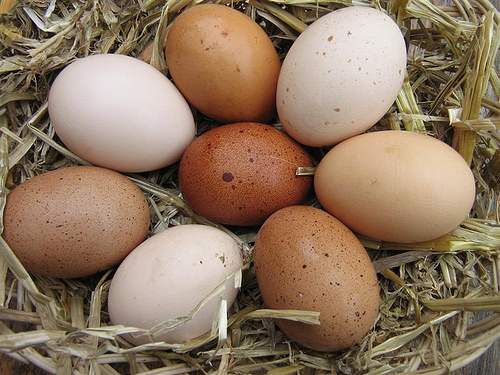
“There are three ways to turn limestone into a structural material. You can cut in into blocks, grind it up and calcine it at about 1500 Celsius into Portland cement, or feed it to a chicken and get it back hours later as even stronger eggshell. If we were as smart as chickens, we might master this elegant near-ambient-temperature technology and expand its scale and speed.”

The next time you design a manufacturing process or building, limit yourself using this framework:

“If a company knew that nothing that came into its factory could be thrown away, and that everything it produced would eventually return, how would it design its components and products?”
Eggs

Elimination of Muda

Muda is Japanese for “waste”, “futility” or “purposelessness”.

A central thesis of the book is that large-scale centralized production is not more efficient than localized small-scale production. The benefits of decentralized production – lower capital investment, greater flexibility, higher reliability, lower inventory cost and lower shipping costs – often far outweigh the benefit of centralized production – a lower price per pound of material or cubic foot of machinery. In decentralized production, all the different processing steps can be carried out immediately adjacent to one  another with the product kept in continuous flow.

“From a whole-system perspective, the giant cola-canning machine may well cost more per delivered can than a small, slow, unsophisticated machine that produces the cans of cola locally and immediately on receiving an order from the retailer.”

“The whole system comprises classical central sewage-treatment plants and their farflung collection sewers – each piece optimized in isolation – is far costlier than such local or even on-site solutions as biological treatment. That is the case because even if the smaller plants cost more per unit of capacity (which they generally don’t), they’d need far less investment in pipes and pumps – often 90 percent of system investment – to collect sewage from a greater area to serve the larger plant.”

WasteWater

Water treatment centrally or in your garden?

Business models for a service economy

Together resource productivity and elimination of muda (lean thinking) offer the foundation for a powerful new business logic: Instead of selling the customer a product that you hope she’ll be able to use to derive the service she really wants, provide her that service directly at the rate and in the manner in which she desires it, deliver it as efficiently as possible, share as much of the resulting savings as you must to compete, and pocket the rest. 

An example of this “new business logic” are Energy Service Companies (ESCo’s). ESCo’s privately finance and install energy saving measures (insulation, energy-saving LED lighting, solar panels) in a client’s building, and charge a monthly fee to the client that is typically less than the energy saved. In a not-so-distant past, engineering firms would charge for the product (insulation materials, solar panels and labor costs for installation) upfront, because of which many potential clients did not become clients because they could not afford the capital expense.

SpaceX_Dragon

Another not-so-earthly example is Elon Musk’s SpaceX. In stead of selling NASA a rocket, SpaceX charges NASA for the service to bring weight into the stratosphere. Through a different design perspective – building reusable in stead of disposable rockets – SpaceX is able to deliver NASA their service for one-tenth of the cost, winning a $1.6B contract.

Other examples are Schindler, a Swiss elevator-manufacturer that makes 70 percent of its earnings by leasing vertical transportation services, and Amazon Web Services. In stead of selling server-racks, AWS provide the service of storing bits. With this new business logic, Amazon created the industry of cloud storage (for which no server-manufacturing-expertise was needed!).

“At first glance it is tempting to regard a company crazy for striving to sell less of its product. If you sell a service, however, you have the opportunity to develop relationships, not just conduct a one-time transaction. The business logic of offering continuous, customized, decreasing-cost solutions to an individual customer’s problems is compelling because the provider and the customer both make money in the same way – by increasing resource productivity. Service providers would have an incentive to keep their assets productive for as long as possible, rather than prematurely scrapping them in order to sell replacements.”

A “service economy” has important macroeconomic implications. In a “goods economy”, purchasing and thereby orders fluctuate vigorously depending on the economy. In a “solutions economy” this volatility is dampened, because access to a solution does not require large investments, only annual service-fees. This would lead to an enormous reduction in the cycle of jobs being created and destroyed.

The shared economy is one incarnation of the service economy. The shared economy – an economy in which people receive service from the unused capital of other individuals – has started to take shape in recent years because technology has enabled fast and efficient distribution of goods and connection between individuals. With smart door-locks and iPhones with internet access, you can reply to a tenant on airbnb, approve her stay and give her digital, 24-hour access to your front door all in a matter of minutes. Before, this was not possible.

Important questions:

  • Why is the idea of “centralized production leads to maximum efficiency” deeply rooted in our minds if it is incorrect?
  • Why has the “service economy” or “solutions economy” – the concept to sell access to a product in stead of the product itself – been adopted by companies only in the last 20 years?
  • Why do product companies – Apple, Philips, Dyson – choose to sell a product in stead of access to a service, if selling a service allows them to build long-term customer relationships?
Unknown's avatar

The art of flying

Clouds from the planeI love to fly. On flights I find time for long stretches of reading. Floating high above the earth’s surface brings a mental distance that is great for reflection.

But the experience of flying can be more tranquil and pleasant if airlines make these small changes:

  • Board passengers in small groups, with group numbers printed in large font on your boarding pass. If it is clear when you are allowed to board the plane, there is no need to push yourself forward in a long line at the gate.
  • Do not interrupt movies for (duty free) announcement messages. Also, why is it not possible for passengers to start movies when the plane is still at the gate or taxiing?
  • Do not turn on all cabin lights on an overnight flight 1 hour before landing. The flight from Boston to Amsterdam takes five-and-a-half hours, leaving 3 hours of sleep between dinner and arrival. Why would you wake everyone up for the final hour-and-a-half? Is it not possible for passengers to switch on their individual reading lights if they want breakfast?

You can try to find tranquility even when your environment disturbs you:

  • Plan to be at the airport early. I have created an annoying habit of delaying my departure to the airport to the latest moment. This led to my first missed flight recently. Plan to be early: you will make up for the “lost time” of leaving early by a gain in mental clarity during your travel to the airport.
  • Do something at the airport that makes you peaceful. Annoyance builds up when you focus your mind on the chaos around you. Listen to classical music, a podcast or an audiobook. I sometimes read even while standing in line to board, although this makes me look like a failed acrobat – trying to move my bags with my feet while keeping my eyes on my reading.
  • Bring an eyemask and ear buds in your carry-on luggage. When you enter the plane, you can take a nap straight away.
  • Talk to strangers. Have a chat with the person sitting next to you at the gate or on the flight. Small talk and jokes bring happiness. Plus: the person sitting next to you may tell you an amazing story (or even become the love of your life).

What are your travel tips? What do you do when you’re waiting at the gate or on the plane? Do you bring special things with you?

Unknown's avatar

Better decisions: 1. expand your options

The choices we make determine who we become. If that is so, don’t you wish you could make better decisions? This blog is the first in a series or posts on “making better decisions”. 

Why am I interested in making better decisions?

Most of our recent human history we have lived in hunter-gatherer societies (from 200,000 up to about 10,000 years ago). Our environment consisted of (1) limited resources and (2) danger lurking around each corner. People with an aversion for loss and a tendency for fear had a natural advantage in this environment. Evolution equipped us with behavioral tendencies such as gluttony and greed (“Eat as much as you can, we may not catch anything the next few days”); stereotyping (“Does he belong to our tribe or not?”) and a desire to fit into social groups (Imagine being an outcast in the middle of the jungle). Our environment today is very different: we have abundant resources and very limited danger.

Because of the shift in environment, some of the behavioral tendencies we have developed do not serve us  today. I believe that we can make better decisions by observing our own behavioral tendencies and to weed out the tendencies that don’t work in our favor.

The form of the series. 

In a number of posts, I will share ways that I try to improve my decisions. This post is the first.

Image

Tip #1: Expand considered options

“Good morning sir, what will it be for you today? We have tasty fried eggs, our french toast is often praised, and we have coffee, tea or orange juice to drink.”

Just another morning in a typical Midwestern diner – just another choice to make. We make choices every day, ranging from the trivial (“what will I eat for lunch?”) to the important (“what will I pursue in my life?”).

To choose, you need options – at the very least you need the option to do or not to do. In a restaurant, your list of considered options may be limited to the menu handed to you by the waiter. Our choice from the list of considered options is influenced by resources (how much money can I spend?); senses (do I feel like omelet, fresh fruit or french toast?) and beliefs (is it healthy to eat meat?).

In the restaurant, you may perceive that your choices are limited to the items on the menu. This idea is false: you could decide to go to the coffee shop next door; you could decide to pick up a loaf of bread in the grocery store; or you could choose to eat free lunch at the office and save money for your holidays. I have resisted the temptation to buy chocolate milk in many of the gas stations on my bicycle trip by thinking of the other things I could spend my money on.

Creativity is essential in expanding your options. Are you a recent graduate looking for a job? Do not limit your choice by the choices of past graduates and peers. Expand your options by brainstorming (1) the work done by people you follow online or your personal heroes and (2) by listing all types of work you have previously enjoyed – from design to organizing to writing.

Whenever I feel “stuck” in a next professional step, creating a list of “things I’d love to do” allows me to look beyond the limited number of paths walked by so many before (consulting, investment banking, big engineering firm).