Unknown's avatar

What is Truth?

In his autobiography, titled “The Story of my Experiments with Truth”, Gandhi writes about his pursuit of Truth:

“For me, truth is the sovereign principle, which includes numerous other principles. This truth is not only truthfulness in word, but truthfulness in thought also, and not only the relative truth of our conception, but the Absolute Truth, the Eternal Principle, that is God.”

When I first read this passage, it was difficult for me to understand what Gandhi meant by absolute truth. Beyond truthfulness, what is Truth?

A short essay by MIT professor Neil Gershenfield helped me understand one answer to the question “What is Truth?”. Gershenfield writes that “scientists do not seek and find truth, they seek and find better models”. When the predictions of planetary motions by Kepler were improved by Newton, Kepler did not become wrong – Newton’s models (and later Einstein’s) were based on different assumptions and had a different accuracy, not a different truth.

By accepting that there is not one absolute truth, we can let go of dogma, and make experiments to explore how reality works (and accept that we will not find “the” answer). Truth is not absolute, but a model.

Armed with this idea, we can move closer towards personal truth. When actions lead to a different outcome than expected – for example, the job we started does not bring us fulfillment – we can write down assumptions why the outcome was different than expected. By testing those assumptions in new situations – moving towards a sales role in stead of engineering, because we assume that computer work does not make us happy – we can learn more about personal truth.

As Gershenfield writes:

“Violations of expectations are opportunities to refine them.”

experiment

Unknown's avatar

Gratitude

Upon my 24th birthday, here is a list of 24 things I am grateful for:

  • People
  • (The wonderful people around the world whom I call) Friends
  • A caring, closely connected family
  • My ability to prepare a healthy, wholesome, tasty meal
  • The marvelous journeys I have made across the earth
  • Books: specifically those in which great people share their thoughts and struggles to become better persons
  • Confidence that I can learn almost anything if I take conscious, persistent action
  • Airplanes
  • The fact that I enjoy working (industriousness)
  • Sunshine
  • Sea
  • Swimming
  • My choice to study engineering, not business
  • Apple Keynote
  • Little attachment to physical goods
  • The feeling that comes from intense Yoga
  • Difficult phases in personal relationships
  • The realization that I have total freedom to do what I want
  • Mountains (in all seasons)
  • Experiences with selfless service at a young age
  • Interactions with people who had decided to use their life purposefully
  • Confrontations with fear
  • An ability to bring people together
  • Nature

May the list grow with time.

Image

Unknown's avatar

On Venezuela

Imagine a poor family living in the swamps of Latin America. The family owns hundreds of acres of land, but fails to farm the land effectively (if at all). Thus, the padre familias has difficulties feeding his children, let alone providing them with education, healthcare and access to information. As a government official, how would you support your citizens? 

During my two week visit to Venezuela, I met such a family. Six months ago, Chavez’ government gave a big truck to the family, for use on their farmland. With a truck, the number of cows could be increased, more meat could be produced and sold, which would lead to increased budget for the family’s basic needs. The truck was given to the family without either constraints or explanation. Within weeks, the family had completely stripped the truck, selling different parts – bodywork, cylinders, wheels – to locals who would use the parts for other purposes. 

Image

Handing out free equipment is clearly an ineffective (or worse, counter-effective) method to develop a nation, but much used by Chavez to win the favor of voters in his country. As Chavez is expected to leave his position as Venezuela’s president for health reasons, maybe it’s time to find other strategies to further develop the country.

Another regular harmful government action is to socialize private companies. During our stayin Venezuela, we heard stories about shipping companies, telecom companies and expensive hotels whose ownership had been claimed by Chavez’ government. If there is a significant chance that your company will be “taken” from you once it grows, you will surely think twice before starting in Venezuela. 

Unknown's avatar

Meaning through service

Could you name three of the Nobel prize winners of the last year?

Not long ago, many men found life’s meaning in providing their families with food, shelter and clothing. It was perceived a very fulfilling task to “do your work” disciplined and without complaint, such that your family could eat and your children could go to school.

Because it is now so common to have your basic needs covered – and often much more – most young women and men do not feel fulfilled by merely “earning a living”. We are looking for something more – we want our lives to be meaningful. In conversations with friends, many have expressed the wish or desire “to have an impact in the world”. This leads many young people to pursue paths where they could one-day run foundations, build software that “reaches millions” or become CEO’s of large corporations. I think this “long-term meaning” is insufficient to bring true fulfillment.

albert-schweitzer

Now, can you name three people who have made a big difference in your life?

If you are like me, you will have difficulty to recall the names of Nobel prize winners – people who made an impact in the world. Fame and “impact” are short-lived, because the world is transient. No one should have difficulty to name the people who made a difference in their lives.

Every day we have the opportunity to give meaning to our lives by helping the people directly around us. We can be helpful through simple actions: visiting your grandmother with groceries, spending a few hours mentoring kids, assisting a friend in preparation for an important meeting. A lot of meaning is found, however, in these small activities. I am not advocating that we give up our quest to provide meaning on a “large scale”, but I urge you to realize that at least as much of a difference can be made in the way you live your life from day to day.

This post was inspired by two readings: Clayton Christensen’s blog on belonging and believing, and Albert Schweitzer’s “Essential Writings”.

Unknown's avatar

Elementary School is more than 1,2,3 – The Importance of Character Development in Early Years

Can you remember an experience in your elementary or high school years that truly shaped your character?

For me, playing field hockey was a key opportunity to build my character. I was not the most skilled of athletes – far from it, in fact. As is relatively common in the Netherlands, I played field hockey. Starting at age 9, the first years of hockey offered little competition. As I grew older, kids were started to be separated into different teams. From that moment onwards, there was a (very) strong incentive to perform. I remember that often when I started the training, I committed to put in twice as much effort as the other players, just to compensate for my skill.

It was a perfect opportunity to build my character at an early age. Most of us can think of several experiences in early adulthood that taught us certain values, but very few have had the opportunity to have such experiences at an earlier age – right when they are fundamentally important.

I strongly believe that elementary schools and high schools should go beyond teaching cognitive skills – reading, writing, mathematics – and start building character. Why? Because research shows that what distinguishes “successful” students later in life is not a difference in cognitive skill at an early age, but a difference in character.

Besides sports, starting and running Projects is a perfect opportunity for learning. That is why I think every child aged 11-12 (the final two years of high-school in most European countries) should have a compulsory project as part of his or her education. The success of such project education heavily depends on the skill of the teacher and the support of parents, other kids and partners. Inherently, project education seems unscalable, because it depends on the quality of people.

My question to you: How can a “project education” module be designed for scalability?

KIPP School in the Bronx

Knowledge is Power Program

Unknown's avatar

Phantom success factors

So many of us work to gain more money, power or status. A little bit may be required for happiness, but above a certain threshold, more money, power or status does not equate to more happiness.

In my perception, money, power and status are phantom success factors. They are a smokescreen that prevents us from seeing the factors that will lead to true happiness. Examples abound of wealthy individuals celebrated as heroes facing depression in their individual lives. True happiness follows from very different factors as freedom; goodness and enlightenment.

If we, as individuals in a society, were to celebrate factors as enlightenment; freedom and goodness, young people would choose their careers differently. No longer would people choose for roles in banks, in stead they would opt to become artists, teachers or entrepreneurs.

It’s up to us to blow away the smoke, and see what really matters.

Thanks to Darinde, Nadine, Pieter, Frithjof for insights

Unknown's avatar

A model for rapid (uncomfortable) learning

Picture yourself sitting at a conference. One of the speakers asks the people in the audience to raise their hand if they prefer electricity from solar over electricity from coal, oil or natural gas. Chances are, you would raise your hand – of course, “greening” our energy system is important. The question is: does this rational decision lead to a change in your behavior?

Last weekend, I participated in Lean Startup Machine Rotterdam. The goal of the weekend was for participants to rapidly test possible business ideas, by relentlessly interviewing potential (i.e. hypothetical) customers. Many gifted programmers or engineers have spent months, if not years, to build beautiful, detailed websites or airplanes, only to find out that nobody wanted to buy their “solution” once it was completed. To reduce time wasted on undesired products, the “Lean Startup” methodology was created by Eric Ries, as a process to test what people want to pay for, before you start building. Following the “Lean Startup” methodology, my goal for the weekend was to identify groups of people who were willing to invest in renewable energy. I was joined in my quest by Jaap Ruoff, Raffi Balder and Daniël Muller.

Looking at your monthly expenses, how do your purchases reflect the things you say you care about? The first thing I learned this weekend was that although many people say renewable energy is important, few care enough about the topic to allocate money to it. We asked 8 parents whether they cared about the societal impact of the money they were saving for their children. Unanimously, the parents shared horror stories about their investments the past years, and that the only thing they cared about was to have a secure, very-low-risk place to store their money.

Retrieving our confidence, we went out again into a wealthy neighbourhood to ask people whether they felt engaged to invest in solar panels on a school. Only 3 out of 19 people answered positively – all three had interpreted the question as if it were the school of their children, unlike many of the other respondents.

This response provided us with a hint: the desire to contribute to sustainable energy projects may be related to a direct social connection to the location. Based on the fact that only 22% to 27% of US citizens have a roof suitable for solar, we decided to develop a solution for a new (hypothetical) customer and pain: one of the lucky quarter of Dutchies that have a solar panel-fit roof, but can’t finance a solar panel system alone. We tested our customer and problem hypothesis in two ways: we built a landing page for an early adopter (someone with his own roof and 3,000 twitter followers) and we started calling friends around a proposal to invest in a local school.

Sure enough, data started pouring in. The landing page we built attracted 255 unique visitors. None of the visitors left their information to buy a “solar share” – our name for the €50 investments visitors could make in the early adopter’s rooftop solar system. From our calls, we learned that our friends were willing to invest a small amount of money (e.g €50) in a private solar panel system, but a larger amount of money (e.g. €200) if the solar panels were installed on a school.

Most importantly, I was reminded how great it is to work with smart people on a challenging project, utilizing an unfamiliar process whilst operating far out of your comfort zone! Approaching people on the street, asking them about their needs will always instill fear initially, but it is such a rewarding experience! Thinking back of similar environments (specifically 3DayStartup in Amsterdam & Social Good Hackathon in Cambridge), these are the kind of environments that foster very rapid learning.

I noted earlier the learning that a societal need is not always equal to an individual pain or desire. If educational institutions can transform their high-level need for innovation to a burning desire, the Learn Startup Machine model can be a medicine to their pain.

Unknown's avatar

The Power of Initiative

Today, it’s easier than ever to send out a message into the world or to start a new organization. Within a few phone-calls, you and I can reach almost any person in the world. 

As the barriers to create value decrease, our power (and responsibility) to write our life narratives becomes bigger. Decades ago, the story of a young man born in rural Kenya was almost fully defined by the situation into which he was born – the “starting conditions” of his life. The same young man born today has a realistic option to craft a life story much different than previously imaginable. In a world where more is possible, initiative – the power to act -is becoming one of the most important conditions for human success.  

More than ever, we have the opportunity to turn our big ideas into reality. Whether we choose a life of action or a life of passive agreement is up to us. With that, I’d like to share a quote from Bucky.

“We are blessed with technology that would be indescribable to our forefathers. We have the wherewithal, the know-it-all to feed everybody, clothe everybody, and give every human on Earth a chance. We know now what we could never have known before: that we now have the option for all humanity to make it successfully on this planet in this lifetime. Whether it is to be Utopia or Oblivion will be a touch-and-go relay race right up to the final moment.”


– Buckminster Fuller, Critical Path

Unknown's avatar

Everybody gets their “musts”; nobody gets their “shoulds”

“Human beings absolutely follow through on who they believe they are.”

You may not like his voice, but Tony Robbins very nicely packages a few key lessons for personal progress in this video.

Take 30 minutes to watch it – and implement his exercises – it will change your state of mind for the better.

Among his advice, which also comes from Napoleon Hill’s “Think and Grow Rich”

1. Define a Compelling Vision (Burning Desire)
2. For which you have Strong Reasons
3. Review it Every Day

Unknown's avatar

Design in entrepreneurship: essential or a luxury? A report from A Better World By Design.

This blog was originally written for MIT Entrepreneurship Review

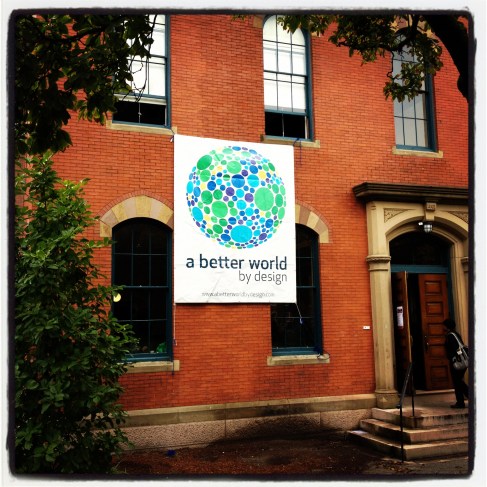
What is the role of design in improving the world we live in? This was the central question at the annual “A Better World by Design” (ABWxD) conference, hosted by Brown University and the Rhode Island School of Design (RISD) last weekend. While some may associate design with beautiful buildings or intuitive software interfaces, conversations at ABWxD extended far beyond this realm. The key take-away from two days in Providence, RI: design plays a fundamental role in the success of any project, extending its influence from technology development to product sales.

In technology development, design is too often an after-thought. Noel Wilson shared the process of redesigning a rollable water vessel for developing countries. Previously, a product had been developed to eliminate the need for people to carry heavy water containers on top of their heads. As Wilson and his team were testing a prior version of the product in the field, Wilson observed that people had difficulties using the sealing mechanism. By involving the end-users, and setting up a prototype facility in a local village, Wilson was able to rapidly iterate through design features, and find those design elements that were most appreciated by users.

It is specifically the interface between user and technology that requires careful design. In a personal conversation, Steve Daniels – who founded ABWxD in 2008 – shared his experience working with IBM Research, by most standards an advanced technology company. For IBM’s Smarter Cities initiative, engineers have been avidly developing technologies that can communicate energy and water consumption to residents. Despite excellent engineering functionality, the researchers realized that analytics alone aren’t enough to change consumer behavior. To create such behavioral change, beautification is not enough: design must be grounded in cognitive psychology and sociology to influence behavior.
Image

Besides technology and product-interface development, the importance of design extends into marketing and communication. A well-visited workshop on Saturday focused entirely on persuasive communication. To make a message stick, good design is essential. Design does not only relate to the form and quality of the communication (e.g. a YouTube video), but also on the source of communication.

Giles Holt, architecture student at RISD University, is one of the co-founders of Consignd. In place of brick-and-mortar stores, Consignd allows users to buy from an influential expert, changing the way we find the products we love. Fundamental to the stickiness of the system is the design, and judging by their website, these guys have a lot up their sleeves. Beyond their product, Consignd has brought a design approach to their business development by applying the same sequence of steps employed by Noel Wilson throughout as they go to market.

If design is fundamental to development and diffusion of innovative products and services, how can it be further integrated into university education? A good example is the annual course Product Design and Development. Taught by MIT professor Steven Eppinger in collaboration with RISD professors, this project-based course stimulates small teams of students to develop a physical product. Beth Soucy, an industrial design student and part of this year’s ABWxD organizing team, was positive about her experience taking the class, collaborating with MIT engineers and business students to develop a tangible product.

Beyond MIT, startup accelerators are picking up on the importance of design too. GreenStart, a San Francisco based accelerator, focuses on giving renewable energy companies a redesign of business, branding and communication.

Having highlighted the importance of design in many different stages of a company’s value chain, it must be noted that design is not a cure-all medicine. Beyond excellent design, transformational companies require an element of technological or business model innovation. In the energy space, this is highlighted by the “energy dashboard delusion”: the idea that visualization of energy consumption would automatically engage home owners to hugely reduce their utility bills.

How do you integrate design into your work? Is design a core element of your business, or do you see it as an extra? Please share your thoughts in the comments section below!