Unknown's avatar

The Best Books I Read in 2025

Welcome to my annual book review. See prior versions here: 2024, 2023, 2022, 2021, 2020, 2019, 2016, 2015, and all time

In 2024, I set two intentions: to consider alternatives to reading books for the purpose of learning (e.g. YouTube, ChatGPT) and to pair reading with action. I picked up a few books this year because they were immediately relevant, and then paired reading those books with action. For example, I used the principles of The Mom Test in customer discovery, and paired Meeting The Shadow with a few therapy sessions to explore my “shadow side”. 

In 2025, I will continue to read books for their direct application. I also plan to pick up at least a few books that have stood the test of time that simply interest me for the sake of curiosity and cultivating a long attention span (e.g. The Power Broker or The Making of the Atomic Bomb). 

I finished 25 books this year. For the full list, check out my Goodreads. On to my top picks for 2025. 

Freedom’s Forge

This is an amazing history book on WW2. Its main premise: the Allies won WW2 because of the industrial production machine, which was built by American private industry. (Hence the book’s subtitle: How American Business Produced Victory In World War II.) 

This story is told through the lives of two protagonists. Bill Knudsen was a former executive at Ford who became President of General Motors under Chairman Alfred Sloan and later led the Office of Production Management. Henry Kaiser was the legendary founder of a large engineering and construction firm known as The Six Companies that built some of the largest Depression-era dams (including Hoover Dam) and built ports, ships, and provided cement during WW2. 

Reading this book got me excited about the ability for business to be a force for good. The book shows how business executives unlocked the American production machine and in doing so defeated the Nazis. It was put well by Stalin in his first meeting with Churchill and Roosevelt in Tehran in 1943 in a toast, “to American production, without which this war would have been lost.” 

This book reminds me of Pieces of the Action, about Vanevar Bush’s role in in WW2. I found this book more thrilling.

Circe 

This is easily one of the best fiction books I’ve read in recent years. I read Miller’s other book, Song of Achilles, in 2024. It’s equally good. Both books are modern retellings of Greek mythology. 

Circe includes the tales of the Titans, Prometheus, Odysseus and the Trojan War, Scylla, Daedalus and Icarus, Minos and the Minotaur, and many more. The book is a story about fear and love, good and bad, life and death. 

Miller’s writing is beautiful without being flowery (e.g. “But I pressed his face into my mind, as seals are pressed in wax, so I could carry it with me.”)

As One Is

This book, a collection of six talks given by Krishnamurti in Ojai, California in the 1950s, makes you uncomfortable. The book’s subtitle says it all: “to free the mind from all conditioning”. 

Krishnamurti reminds you that you live in a mirage if you are not fully present. He writes provocatively, challenging assumptions. This book is worth returning too; it’s best read a few pages at a time. As Krishnamurti advises in almost every talk, “don’t just hear the words, try to validate what I say with your own experience”.

I also listened to Eckhart Tolle’s The Power of Now this year, which has a similar message: be here now. I would recommend that book too. 

Project Hail Mary

This is a riveting sci-fi book about a human astronaut on a journey to save humanity who becomes allies with an alien. It was a real page-turner. I enjoyed how the author had two plots that developed in the opposite chronological order (one forwards in time; the other backwards). 

Some of the interesting ideas explored in this book: a life form (astrophage) that takes energy from the sun and is incredibly energy-dense; an alien language based on sound, not light (think of bats); a counting system in base 6, rather than base 10; a culture around watching each other sleep but not watching each other eat.

On sci-fi, I also read Children of Time this year (which I found to be less gripping) and Daemon (which was a lot more dystopian). I still think The Three Body Problem is one of the best sci-fi books I read in the last few years. 

I also really enjoyed reading “If the universe is teeming with aliens… where is everybody”, which includes fifty possible explanations to the Fermi paradox.

Skunkworks

This book was recommended by my friend Damien. It tells the story of how Lockheed’s Skunk Works developed some of the most innovative aircraft of the 20th century: the Stealth Fighter used in Operation Desert Storm (F-117A), the SR-71 (Blackbird), and the U-2 spy plane. 

The story is told from the perspective of Ben Rich, who took over as CEO from the founder of Skunk Works, Kelly Johnson. The chapters are interspersed with perspectives from others, titled “Other Voices”. 

This book gets you all fired up about building, similar to How Big Things Get Done, Freedom’s Forge, or The Founders (about Paypal). 

Creatiespiraal

As far as I know, this book is available only in Dutch. It was recommended by my friend Steven Blom. The book introduces a cycle of creation, loosely inspired by Joseph Campbell’s hero’s journey. I found it incredibly helpful to read this as I took a period of rest (sabbatical) and I’m exploring my next adventure. I would recommend this book to anyone who reads Dutch. 
Unknown's avatar

The Best Books I Read In 2021

In 2021, I read 25 books, roughly one every two weeks, mostly non-fiction. In this blog, I share some of my favorites, like I’ve done in previous years (2020, 2019, 2016, 2015, and all time.) If you want to see all the books I read this year, check out my Goodreads account

What does it mean for me to consider a book great? I’ve come to see it mostly means that the book’s message resonated with me, finding me at the right time. To help you decide if you should pick up any of the books below, I’ve added a few sentences on why I found each book helpful. 

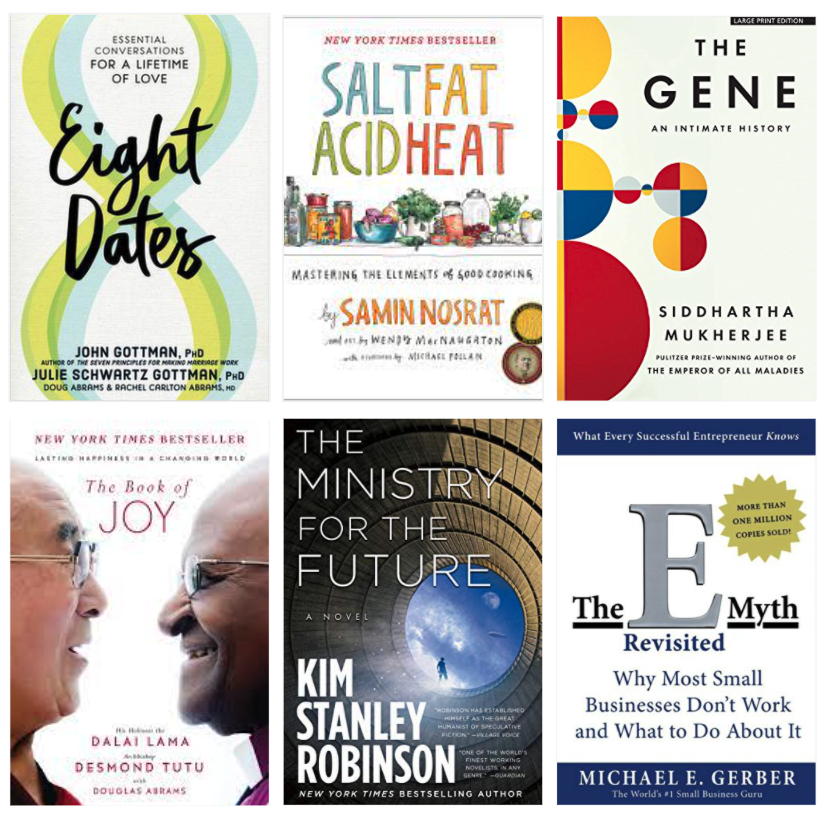
Eight Dates

This was the most useful book I read this year. Written by relationship psychologists John and Julie Gottman, it’s a workbook meant to deepen connection with your romantic partner. It provides recipes for eight distinct dates, each covered in a separate chapter. Each chapter goes into a certain topic — e.g. sexuality, money, family, values — and provides a set of questions and prompts that help you and your partner have an intimate conversation. While the book itself or the topics weren’t particularly surprising, doing the eight dates was transformative. I gave copies to at least 5 other couples and would highly recommend it.

Salt, Fat, Acid, Heat

This was another book that impacted my day-to-day life. It’s a cookbook that’s not a list of recipes. Instead, it dives into the physics and chemistry of cooking, using a four-part framework: salt, fat, acid, and heat. The book helped me better understand what was happening to the food I was preparing. For example, why to add vinegar to water before poaching eggs (it helps the proteins coagulate), why to add mustard to dressings (oil and vinegar don’t go together, so you need an emulsifier), and why to add wait until frying oil is hot before adding foods to the pan (frying oil is not meant for seasoning but texture). 

The Gene

This is a sweeping tome that summarizes the last century or so of progress in understanding how genetic information determines who we are. It’s written beautifully by Sidhhartha Mukherjee, who won a Pullitzer for his book about cancer, The Emperor of All Maladies.

I am fascinated by past and expected progress in biology. This book explains biology’s progress through the lens of the progress made by different scientists, starting with Mendel and Darwin. At nearly 500 dense pages it requires attentive reading, but I found it to be absolutely worthwhile. The final few chapters consider the ethical impact of gene editing, in which Mukherjee takes the zoomed-out view that I enjoy in the writing of writers like Yuval Noah Harari or Jared Diamond. 

The Book of Joy 

This beautiful book captures a week-long dialogue between the Dalai Lama and Archbishop Desmond Tutu on the topic of Joy. Both men inspire me: their zest for life, their ability to laugh in the face of hardship, and their unbounded compassion. 

I listened to this as an audiobook. While the Audible version is not a true recording of the conversation, it had good voice actors. You can easily listen to this book piecemeal, which makes it a good book to digest on the go. 

Ministry for the Future 

This is the best novel I read this year. Written by a science fiction author, this book is all about the possible disastrous impact of climate change and what might be done to drive action sooner. The author, Kim Stanley Robinson, introduces a variety of intriguing technology and policy ideas. For example, could we halt the speed of glacial melt by removing meltwater stuck between the Antarctic rock bed and the glaciers? Can central banks play a role in accelerating carbon sequestration? This is a must-read for anyone working on climate change. 

E-Myth Revisited

This was the best business book I read this year. In it, Michael Gerber explains how to build a large, scalable enterprise. The first part of the book suggests each founder embodies three roles: an Entrepreneur, a Manager, and a Technician. Gerber explains that all founders have to play the role of Technician in a company’s early days, but then fail to let go of this role as a company grows, which hinders further growth. He shows people how to let go, learning to work *on* the business, not *in* the business. This mental shift strongly resonated and I found practical wisdom in the lessons described.

2022 Plans

I’m always looking for books that can transform. What books have most influenced you? Please leave a comment or send me an email. Thank you!

Unknown's avatar

Could technology supplant meditation?

My first-ever Vipassana meditation was in Amsterdam. Sitting on a little pillow, our teacher told us that the key to Vipassana meditation is to observe your own thoughts without attachment.

In the following weeks, I invited several friends to those Vipassana sessions. After 90 minutes of meditation, we’d go for a drink and wonder: what happens to your brain when you meditate?

In his TED-talk, Mathieu Ricard answers this question. He shows pictures of Buddhist monks lying inside big fMRI machines. The monks are subjects in a research study to understand the influence of meditation on the structure of the brain. The research showed that the brain structure changes through meditation: monks show more neural activity when they look at images that raise our sense of empathy.

meditationvpain

After seeing this image, I wondered if a Buddhist monk would agree to use a technology that instantly creates the effect of meditation, without the many years of practice it typically takes to create a truly tranquil mind. In the last month, I learned that the first signs of such a technology exist. Called transcranial Direct Current Stimulation (tDCS); it’s so simple that you can build a setup for less than $50.

I first learned about tDCS in The Economist’s Technology Quarterly, and by listening to a fascinating podcast by Radiolab. In the episode, a journalist for New Scientist explains how her performance in a military simulation game improved from sub-standard to perfect, simply by running a bit of electricity through her brain. (She participated in a military training simulation; her goal was to survive a danger situation in Afghanistan. Without tDCS, she shot 3 out of 20; with tDCS, she hit all targets.) When she performed the exercise without the brain stimulation, she felt extremely stressed; when she used tDCS, time seemed to slow down, decisions were much simpler, and, at the end of the game, the journalist asked the supervisor why they had skipped the hard part of the simulation. Effectively, tDCS creates an effect that meditation can create too: it brings you into a state of focus—letting go of doubts, worries, and peripheral thoughts.

What could this mean for our future? Will baseball-caps provide electric shocks to our brain to keep us in a constant state of “flow”? Is it possible to keep the brain in a constant high; or would our neural cells set the electric current as the new normal, requiring a higher power-flow? If technology can create a focused mind, would a monk use it, or would using it fail to complete the deeper goal of non-attachment?

###

(After I listened to this episode, I ordered a tDCS device myself. I’m very curious to see what it does.)

Unknown's avatar

3 cool tools to learn how computers work

1. Kano: a $150 kit to build your own computer. Kano ships you a beautiful package with a Raspberry Pi, a case, a small speaker, a keyboard with trackpad, and a WiFi module. Using Pi’s linux operating system, you can download existing games, or build your own.

2. littleBits – a library of magnetic electronic blocks that allow you to create and invent. littleBits is an ever-growing library of electronic modules that snap together with magnets so you can invent anything without the need to solder or connect wires. LittleBits’ library has 60 modules, including temperature sensors, microphones, buttons, motors and many more.

3. arduino is an open-source electronics platform that provides the raw material for anyone making interactive projects. At MIT, several of my friends used arduinos to prototype their solution. After teaching at MIT’s medialab India Design Initiative, I was so interested that I bought an arduino as part of a SparkFun kit. I used the kit to build several designs, and then I created my own thermostat. It wasn’t connected to my heating system, but the output (a light) would switch on if the boiler had to switch on.

The thermostat I built with my arduino-kit. When the temperature would be below the setpoint (21 C), the output (an LED, in this example), would switch on.

The thermostat I built with my arduino-kit. When the temperature would be below the setpoint (21 C), the output (an LED, in this example), would switch on.

###

Do you want to understand the basics of computers? Get Danny Hillis’ terrific book “The Pattern on the Stone”. The book details through clear examples how computers work, without going into unnecessary details and all the time nurturing curiosity.

Unknown's avatar

Medialab in Mumbai

MIT performance capture group

I returned yesterday from Mumbai to Amsterdam. I had the honour of being one of the teachers at the MIT Medialab India Initiative. We brought together 350 Indian college students, with backgrounds in engineering and design, with the goal to design and build solutions for a better (Indian) future. It was without doubt the most rewarding teaching experience I have ever had. Why?

There was no competition between student groups (in fact, computer science students from one group would regularly sit for an hour with another group who had no coders); all students were fully engaged in participation; every single student tried things he had never done before (from programming an arduino to printing a PCB); and we had so much fun.

In fact, I was able to learn new things myself: how to build a circuit with no other materials than paper, copper wire, a battery and an LED; how to solder and how to get a group of 20 young males to dance.

The 34 students in my group created 8 prototypes within 2 days of building. See the presentation below, and be inspired.

###

If you’re interested in how the workshop was led, please reach out for the curriculum.

Unknown's avatar

A brainstorm on collaborative consumption

Brainstorm

Many of the things on our planet are not used efficiently. Cars stand idle in parking places and unemployed young people are waiting for interesting work. How can we use this wasted potential by creating transparency in what’s available (supply) and what’s needed (demand)?

Yesterday’s brainstorm started with this question. Soon the conversation shifted to other questions:

  • Can we go beyond looking for inefficiencies towards thinking of different sharing systems?
  • If there were to be an open source template for sharing platforms, would people use it?

Below is a collection of the summary of our conversation; the ideas that were born and further food for discussions.

Trends that enable collaborative consumption:

Drivers_Collaborative_Consumption

Takeaways: 

Multiple functions per object increase possible value. When your apartment can serve as a dinner-room, fitness studio and professional kitchen, you can capture different value streams (see Graham Hill’s NYC apartment, courtesy of Nils Beers). When your factory can produce different models of cars in stead of one model, you can utilize the factory much more efficiently (listen to NPR’s radio show on the NUMMI factory).

There is a tension between increased collaborative consumption (i.e. posting of what you want and what you have to offer) and privacy.

To think about next time:

  • What is the role for people who do not work jobs anymore but are capable to do physical, intellectual or emotional work?
    • Distribute research questions to individuals – citizen science v2
    • Take care of children
    • Beta testing software (maybe even debugging?)
  • How would you control the motion of people around our globe if you had an astronaut’s perspective?

Three cool ideas:

  1. Eindstanden krant: a newspaper that reports on final outcomes only
  2. Micropayments to manage the flow of people around a city (remember picking up and dropping people in Roller Coaster tycoon?)
  3. In stead of firing people when a company faces a shortage of work, lend people to other companies (this is standard practice with many soccer teams)
Unknown's avatar

Deal with whatever life brings you

Image

Creative Commons masha_k_sh

Worth reading every morning:

“Each separate being in the universe, returns to the common source. Returning to the source is serenity.

If you don’t realize the source, you stumble in confusion and sorrow.

When you realize where you come from, you naturally become tolerant, disinterested, amused, kindhearted as a grandmother, dignified as a king.

Immersed in the wonder of the Tao, you can deal with whatever life brings you.”

Unknown's avatar

Better decisions: 1. expand your options

The choices we make determine who we become. If that is so, don’t you wish you could make better decisions? This blog is the first in a series or posts on “making better decisions”. 

Why am I interested in making better decisions?

Most of our recent human history we have lived in hunter-gatherer societies (from 200,000 up to about 10,000 years ago). Our environment consisted of (1) limited resources and (2) danger lurking around each corner. People with an aversion for loss and a tendency for fear had a natural advantage in this environment. Evolution equipped us with behavioral tendencies such as gluttony and greed (“Eat as much as you can, we may not catch anything the next few days”); stereotyping (“Does he belong to our tribe or not?”) and a desire to fit into social groups (Imagine being an outcast in the middle of the jungle). Our environment today is very different: we have abundant resources and very limited danger.

Because of the shift in environment, some of the behavioral tendencies we have developed do not serve us  today. I believe that we can make better decisions by observing our own behavioral tendencies and to weed out the tendencies that don’t work in our favor.

The form of the series. 

In a number of posts, I will share ways that I try to improve my decisions. This post is the first.

Image

Tip #1: Expand considered options

“Good morning sir, what will it be for you today? We have tasty fried eggs, our french toast is often praised, and we have coffee, tea or orange juice to drink.”

Just another morning in a typical Midwestern diner – just another choice to make. We make choices every day, ranging from the trivial (“what will I eat for lunch?”) to the important (“what will I pursue in my life?”).

To choose, you need options – at the very least you need the option to do or not to do. In a restaurant, your list of considered options may be limited to the menu handed to you by the waiter. Our choice from the list of considered options is influenced by resources (how much money can I spend?); senses (do I feel like omelet, fresh fruit or french toast?) and beliefs (is it healthy to eat meat?).

In the restaurant, you may perceive that your choices are limited to the items on the menu. This idea is false: you could decide to go to the coffee shop next door; you could decide to pick up a loaf of bread in the grocery store; or you could choose to eat free lunch at the office and save money for your holidays. I have resisted the temptation to buy chocolate milk in many of the gas stations on my bicycle trip by thinking of the other things I could spend my money on.

Creativity is essential in expanding your options. Are you a recent graduate looking for a job? Do not limit your choice by the choices of past graduates and peers. Expand your options by brainstorming (1) the work done by people you follow online or your personal heroes and (2) by listing all types of work you have previously enjoyed – from design to organizing to writing.

Whenever I feel “stuck” in a next professional step, creating a list of “things I’d love to do” allows me to look beyond the limited number of paths walked by so many before (consulting, investment banking, big engineering firm).

Unknown's avatar

Book review: Benjamin Franklin’s autobiography

Image

Written 250 years ago, Benjamin Franklin’s autobiography is surprisingly easy to read. In today’s world, Franklin would be a mix between Tim O’Reilly and Tim Ferris. Franklin operated a printing company through which he influenced public opinion; he founded organizations as a fire brigade and a university and he actively tried to change the way he acted through smart exercises and habits. I found it valuable to read his autobiography because Franklin was on a relentless pursuit to become a better person. In his own words:

“I grew convinced that truth, sincerity and integrity in dealings between man and man were of the utmost importance to the felicity of life; and I formed written resolutions which still remain in my journal book to practice them ever while I lived.”

I wrote about one exercise to nurture your virtues in a post one year ago. Below are some of the thoughts flowing from his book.

# Study voraciously

Franklin took all the time he could to read. At sixteen Franklin became vegetarian, so he could eat a light lunch at his office, saving money and time to read more books.

# Changing someone else’s opinion

Socrates’ method of inquiry – as documented in Xenophobon’s book – is a tool to let other people rethink their beliefs or opinion on a subject by mastering the art of questioning. Franklin also taught himself to avoid argument. When he disagreed with someone, he would put his remark in the form of a question “Do you not think that the issue can be seen from another perspective?”. The point he makes is phrased by Alexander Pope as:

“Men should be taught as if you taught them not, and things unknown proposed as things forgot”

# Build relationships

Benjamin Franklin was recommended by two Governors for his work. “This was the second governor who had done me the honor to take notice of me; which, to a poor boy like me, was very pleasing.”

# An exercise to learn to write 

Franklin learned to write by sending in pieces to his brother’s printing press under the name of an invented elderly lady. Franklin describes one exercise he used to improve his writing: Take a piece of work that you think is well-written and copy the essence of every sentence. Put the notes to the side for a few days. Then, pick up the notes and try to recreate the original essay from the notes. Compare your paper to the original, and observe where and how the author of the original created different sentences.

# Stick to your principles

A friend who travelled alongside Franklin from NYC to Philadelphia was drunk and did not want to row when it was his turn to take the oars. Franklin insisted he would, because he saw every man on the team as equal. Here, Franklin was a man of principle – not bending to suit a friend who drank.

# Work with the best

When Franklin arrived in England, under the false conviction that the Governor had set up meetings for him with printers, he had to look for something else to do. He was advised to work with experienced printers in the UK; training with whom would allow him to set up his own shop afterwards.

# Learn to say no to requests

When he speaks about a governor who did not keep his promise. “It was a habit he had acquired. He wished to please everybody; and, having little to give, he gave expectations. He was otherwise an ingenious, sensible man […]”

# Think independently 

At the time Franklin started work in a printing press in England, the workmen at the printing press would drink beer during the working day, supposing they needed the beer for nutrition. Franklin reasoned that the nutritional value of 6 pints of beer could be no more than a loaf of bread, because:

“The strength afforded by beer could only be in proportion to the grain or flour of the barley dissolved in the water of which it was made.”

Franklin did not drink beer and was a better worker and wealthier man as a result.

# Be ethical in your work

Franklin refused to print advertisements or letters that spoke negatively of others.

“I carefully excluded all libeling and personal abuse.”

When his customers would claim “freedom of press”, Franklin would respond by saying that he would print the article for them, but that he would not distribute such a piece.

# Find smart ways to learn

When Franklin wanted to learn Italian, he found another student with whom he would play chess. The winner of a game was allowed to impose a language-learning task on the other.

Franklin also created a “club of mutual improvement” called the junto. The group would meet every week to discuss questions on morality, politics or science. 

# Turn enemies into friends

One man spoke against Benjamin Franklin. In stead of attacking him, or writing him a nasty letter, or even asking “Why did you attack me?”, Franklin tried a different tactic: he asked the man to use something he deeply cared about. Franklin asked to borrow a book, which the man highly treasured.

“He that has once done you a kindness will be more ready to do you another, than he whom you yourself have obliged.”

Try to think in opportunities when someone reproaches you – try to tickle their interests.

# Spread ideas through writing

Franklin used the written word as a method for spreading his ideas. He would come up with a solution to a social problem – for instance, an Academy to reduce the levels of illiteracy in Philadelphia – write a convincing essay, share it with friends to receive feedback, and publish it into local newspapers. This is no different from the method Elon Musk uses today to spread the idea of the Hyperloop.

Glancing over the different lessons learned, Franklin’s autobiography could easily fit into a business-book section.

Unknown's avatar

Which world do you live in?

Image

There are always a few who are not content to spend their lives indoors. Simply knowing there is something unknown beyond their reach makes them acutely restless. They have to see what lies outside – if only, as Mallory said of Everest, “because it’s there”.

This is true of adventurers of every kind, but especially of those who seek to explore not mountains or jungles but consciousness itself: whose real drive, we might say, is not so much to know the unknown as to know the knower. 

The earliest books we know today that contain the experiences of these explorers of consciousness are the Upanishads, the Dhammapada and the Bhagavad Gita. Eknath Easwaran has delivered a terrific job in translating all three books for Western readers, not only translating, but also adding brief introductions to every chapter of the books. 

The Upanishads are […] so varied that we feel some unknown collectors must have tossed into a jumble all the photos, postcards and letters from this world that they could find, without any regard for source or circumstance. […] they form a kind of ecstatic slideshow – snapshots of towering peaks of consciousness taken at various times by different observers.


The Dhammapada is a collection [of] sayings of the Buddha. If the Upanishads are like slides, the Dhammapada seems more like a field guide. [The author] urges us that it is our destiny as human beings to make this journey [of consciousness] ourselves. Everything else is secondary.


The Bhagavad Gita gives us a map and guidebook. It gives a systematic overview of the territory, shows various approaches to the summit with their benefits and pitfalls, offers recommendations, tells us what to pack and what to leave behind. It asks and answers the questions that you or I might ask – questions not about philosophy or mysticism, but about how to life effectively in a world of challenge and change.

The Upanishads, Dhammapada and Bhagavad Gita insist that the wider world of consciousness is our native land. We are meant to explore, to seek, to push the limits of our potential as human beings. The world of the senses is just a base camp: we are meant to be as much at home in consciousness as in the world of physical reality.


Do you take time to explore the world of consciousness?