Unknown's avatar

The Best Books I Read in 2024

Welcome to my annual book review. See prior versions here: 2023, 2022, 2021, 2020, 2019, 2016, 2015, and all time

Last year I wrote that I would run two experiments in 2024:

  1. To read more actively
  2. To consider alternatives to reading for learning

On the second experiment, I would rate myself a 6 out of 10. I still primarily default to books, podcasts, and ChatGPT. I don’t use YouTube that much. 

I would rate myself an 8 out of 10 on reading more actively.  I tried to pick up books that have some direct application to what I was doing. 

As an example, when I read Peter Attia’s book Outlive, I did a detailed blood marker test via Function Health. Based on those results, I started to take supplements and changed my exercise pattern. 

Or, as another example, when I read Richard Schwartz’s book, You Are the One You’ve Been Looking For about Internal Family Systems (IFS), I started working with an IFS therapist.

In addition to pairing reading with follow-up actions, I’ve been using ChatGPT to read more actively. While reading non-fiction books, I use it to ask questions to clarify what I’m reading.

I’ve also been using AI to distill and remember a book’s key concepts. For instance, I’ve used Gemini to create questions and answer pairs based on my Kindle highlights. Then, I pop those into Anki, the spaced repetition app.

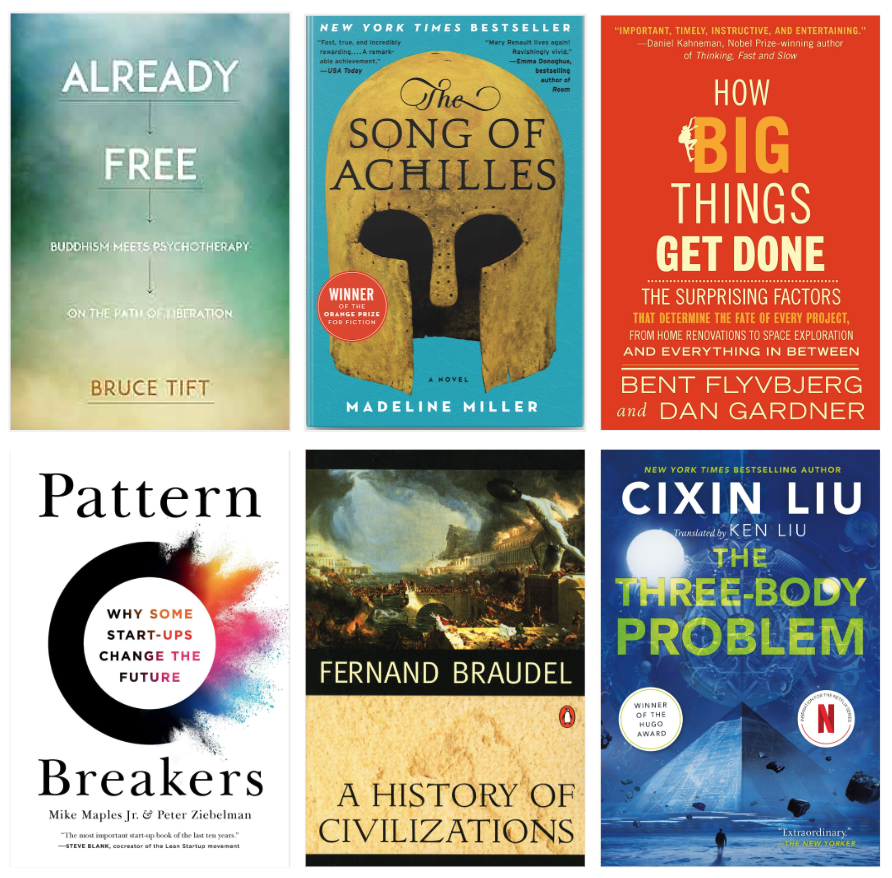
On to my top picks for 2024. I read 22 books this year. See my top 6 below. For the full list, check out my Goodreads.

Already Free by Bruce Tift

This book was recommended to me by my friend Aart. It’s written by a lifelong meditator and psychotherapist. In it, he tries to marry Eastern and Western views on psychology. The Western view, which he calls developmental, supposes that by working on yourself, you can improve. The Eastern view, which he calls fruitional, supposes that sensations will never go away and that the practice is to be able to sit with them. I would highly recommend this book.

One of the key concepts that I still refer to regularly is the spectrum of separating vs. connecting. Tift writes that most of us have a tendency to either be connecting, which can mean pleasing others, or separating, which can mean declining requests for attention. This is something I have been playing with this year. Since finishing the book I have done a few one-on-one consulting sessions with Bruce and I intend to continue those. 

Song of Achilles by Madeline Miller

This was the best-written novel I read this year. It’s set before and during the Trojan war, in which Achilles, Menelaus, and others fight against Troy. Izzy and I read this together and really enjoyed it. 

How Big Things Get Done by Brent Flyvbjerg

This is an amazing book about why so few large projects get completed on time and on budget (only 8 out of 100 projects, according to the author’s extensive database), recommended by my friend Alex. The book starts with the story of the Empire State Building, which went from construction start to completion in just 1 year and 45 days. The book is written by an Oxford professor who has spent his entire career delivering big projects.

A key concept to deliver projects on-time and on-budget execution is modularity. This is why solar panels are such an incredible technology. As I was reading this book, I got increasingly excited about building big projects. I would recommend this book to any engineer, architect, or builder. The book also reminds me of Patrick Collison’s web page about rapidly delivered projects: https://patrickcollison.com/fast

Pattern Breakers by Mike Maples, Jr. 

Maples is a Silicon Valley seed investor. While many books are written about how to start and grow a startup, few discuss what ideas are worth pursuing. That’s what this book is about.  

Maples introduces two main concepts:

  1. Inflections. These are secular trends that change the landscape. For example, if AI reaches human-level intelligence and is given ways to act on our behalf, we might all have virtual personal assistants. Or, if solar and batteries become 80% cheaper, it might mean that the cheapest way to produce fuel is by producing it from zero-carbon power.  
  2. Insights. These are non-obvious truths about how to harness one or more inflections to change human capacities or behaviors in a radical way. As an example, Wispr Flow, an AI dictation app, is powered by the insight that talking is more natural (and possibly faster) than typing. 

I took a lot of notes while reading this book. It offered a great lens to look at businesses I am involved in and that I admire. It also offers a great framework to look at future companies. 

History of Civilizations by Ferdinand Braudel

This is a history book written in the 1970s by a well-regarded French historian. He provides a sweeping history of human civilizations. I enjoy how Braudel draws broad trends while providing specific anecdotes. For example, the United States became a British colony, not a French one, despite the French being there first. Why? Britain sent many more people to America. When the British-French war broke out in 1760, there were 1 million British and only 60 thousand French. The book has some similarity to The Lessons of History by Will and Ariel Durant. 

Three Body Problem series by Cixin Liu

I had read the first book in this three-part series a few years ago and read numbers two and three this year. These books are page-turners. Liu introduces a wide range of concepts, ranging from light speed propulsion to reducing the number of dimensions as a method to attacking other species. And, of course, dark forest theory: if there is other intelligent life in the universe, it is safest for them to not show signs of existence and to annihilate any other intelligent life without investigating. 

I also loved the composition of the books. For example, I loved the stories Liu invents in book three, that hide secrets for humanity about the technology they ought to develop.

Unknown's avatar

Book review: Benjamin Franklin’s autobiography

Image

Written 250 years ago, Benjamin Franklin’s autobiography is surprisingly easy to read. In today’s world, Franklin would be a mix between Tim O’Reilly and Tim Ferris. Franklin operated a printing company through which he influenced public opinion; he founded organizations as a fire brigade and a university and he actively tried to change the way he acted through smart exercises and habits. I found it valuable to read his autobiography because Franklin was on a relentless pursuit to become a better person. In his own words:

“I grew convinced that truth, sincerity and integrity in dealings between man and man were of the utmost importance to the felicity of life; and I formed written resolutions which still remain in my journal book to practice them ever while I lived.”

I wrote about one exercise to nurture your virtues in a post one year ago. Below are some of the thoughts flowing from his book.

# Study voraciously

Franklin took all the time he could to read. At sixteen Franklin became vegetarian, so he could eat a light lunch at his office, saving money and time to read more books.

# Changing someone else’s opinion

Socrates’ method of inquiry – as documented in Xenophobon’s book – is a tool to let other people rethink their beliefs or opinion on a subject by mastering the art of questioning. Franklin also taught himself to avoid argument. When he disagreed with someone, he would put his remark in the form of a question “Do you not think that the issue can be seen from another perspective?”. The point he makes is phrased by Alexander Pope as:

“Men should be taught as if you taught them not, and things unknown proposed as things forgot”

# Build relationships

Benjamin Franklin was recommended by two Governors for his work. “This was the second governor who had done me the honor to take notice of me; which, to a poor boy like me, was very pleasing.”

# An exercise to learn to write 

Franklin learned to write by sending in pieces to his brother’s printing press under the name of an invented elderly lady. Franklin describes one exercise he used to improve his writing: Take a piece of work that you think is well-written and copy the essence of every sentence. Put the notes to the side for a few days. Then, pick up the notes and try to recreate the original essay from the notes. Compare your paper to the original, and observe where and how the author of the original created different sentences.

# Stick to your principles

A friend who travelled alongside Franklin from NYC to Philadelphia was drunk and did not want to row when it was his turn to take the oars. Franklin insisted he would, because he saw every man on the team as equal. Here, Franklin was a man of principle – not bending to suit a friend who drank.

# Work with the best

When Franklin arrived in England, under the false conviction that the Governor had set up meetings for him with printers, he had to look for something else to do. He was advised to work with experienced printers in the UK; training with whom would allow him to set up his own shop afterwards.

# Learn to say no to requests

When he speaks about a governor who did not keep his promise. “It was a habit he had acquired. He wished to please everybody; and, having little to give, he gave expectations. He was otherwise an ingenious, sensible man […]”

# Think independently 

At the time Franklin started work in a printing press in England, the workmen at the printing press would drink beer during the working day, supposing they needed the beer for nutrition. Franklin reasoned that the nutritional value of 6 pints of beer could be no more than a loaf of bread, because:

“The strength afforded by beer could only be in proportion to the grain or flour of the barley dissolved in the water of which it was made.”

Franklin did not drink beer and was a better worker and wealthier man as a result.

# Be ethical in your work

Franklin refused to print advertisements or letters that spoke negatively of others.

“I carefully excluded all libeling and personal abuse.”

When his customers would claim “freedom of press”, Franklin would respond by saying that he would print the article for them, but that he would not distribute such a piece.

# Find smart ways to learn

When Franklin wanted to learn Italian, he found another student with whom he would play chess. The winner of a game was allowed to impose a language-learning task on the other.

Franklin also created a “club of mutual improvement” called the junto. The group would meet every week to discuss questions on morality, politics or science. 

# Turn enemies into friends

One man spoke against Benjamin Franklin. In stead of attacking him, or writing him a nasty letter, or even asking “Why did you attack me?”, Franklin tried a different tactic: he asked the man to use something he deeply cared about. Franklin asked to borrow a book, which the man highly treasured.

“He that has once done you a kindness will be more ready to do you another, than he whom you yourself have obliged.”

Try to think in opportunities when someone reproaches you – try to tickle their interests.

# Spread ideas through writing

Franklin used the written word as a method for spreading his ideas. He would come up with a solution to a social problem – for instance, an Academy to reduce the levels of illiteracy in Philadelphia – write a convincing essay, share it with friends to receive feedback, and publish it into local newspapers. This is no different from the method Elon Musk uses today to spread the idea of the Hyperloop.

Glancing over the different lessons learned, Franklin’s autobiography could easily fit into a business-book section.